Showing posts with label information processing. Show all posts

Thursday, October 16, 2025

IQs Corner pub alert: CHC theory of cognitive abilities used to define and evaluate AI - #AI #CHC #intelligence #schoolpsychology #schoolpsychologists #IQ #EDPSY

An exciting new paper from the Dan Hendryks et al. at the Center for AI Safety  The center is  a nonprofit with the mission “to reduce societal-scale risks from artificial intelligence.”  In this just released paper, they propose a modified CHC theory definition/framework for evaluating AI: 
  • AGI is an AI that can match or exceed the cognitive versatility and proficiency of a well-educated adult.”
Given my extensive research and publications regarding the Cattell-Horn-Carroll (CHC) theory of cognitive abilities, I was pleasantly surprised when Dan reached out for my comments and suggested revisions to the paper.  

I was extremely impressed as Dan and his group had been involved in a deep dive in the CHC literature and had developed, without my involvement, an ingenuous internet-based CHC set of “test” items that can be submitted to different AI agents (GPT-4, GPT-5, Grok) to assess their CHC broad ability domain performance (to evaluate the extent to which AI agents demonstrate the “cognitive versatility and proficiency of a well-educated adult”).  I had zero involvement in the conceptualization or development of the AI modified/adapted CHC assessment framework and resulting CHC AI metrics. 

I want to express my appreciation to Dan for including me among the list of over 24 authors.  I’m very excited to monitor future developments by Dan and his group, as well as to see the impact of the CHC theory model on AI.

Links to secure copies of the paper (in various formats and social media platforms) are listed at the bottom of this post.  

Note.  Click on all images to enlarge for easy reading

Abstract

The lack of a concrete definition for Artificial General Intelligence (AGI) obscures the gap between today's specialized AI and human-level cognition. This paper introduces a quantifiable framework to address this, defining AGI as matching the cognitive versatility and proficiency of a well-educated adult. To operationalize this, we ground our methodology in Cattell-Horn-Carroll theory, the most em-pirically validated model of human cognition. The framework dissects general intelligence into ten core cognitive domains—including reasoning, memory, and perception—and adapts established human psychometric batteries to evaluate AI systems. Application of this framework reveals a highly “jagged” cognitive profile in contemporary models. While proficient in knowledge-intensive domains, current AI systems have critical deficits in foundational cognitive machinery, particularly long-term memory storage. The resulting AGI scores (e.g., GPT-4 at 27%, GPT-5 at 58%) concretely quantify both rapid progress and the substantial gap remaining before AGI.

Modified CHC model for evaluating AI agents

Click on image to enlarge.


As mentioned in the abstract, the paper reports on the CHC AGI capabilities of GPT-4 and GPT-5 in the following figure.  Click on images to enlarge.


I was pleased to see (on page 14 of the PDF paper) the following “intelligence as processor” figure which is based on work by myself and Joel Schneider. The model in Figure 3 (below) is based on Kevin S. McGrew and W. Joel Schneider. CHC theory revised: A visual-graphic summary of Schneider and McGrew's 2018 CHC update chapter. MindHub / IAPsych working paper, 2018.  http://www.iapsych.com/mindhubpub4.pdf 

The Schneider & McGrew (2018) heuristic CHC information processing model is below the Figure 3 figure.  Click on images to enlarge.


Dan Hendrycks and the Center AI Safety provide brief overviews describing this work on LinkedIn as well as Twitter/X (both that can be monitored for comments).

A PDF copy of the paper can be downloaded here.  A clickable web-based version of the paper can be accessed here.

Exciting stuff !!

Wednesday, May 16, 2018

Higher intelligence related to more efficiently organized brains-bigger/larger/more not always better


Click on image to enlarge

Diffusion markers of dendritic density and arborization in gray matter predict differences in intelligence. Article link.

Erhan Genç, Christoph Fraenz, Caroline Schlüter, Patrick Friedrich, Rüdiger Hossiep, Manuel C. Voelkle, Josef M. Ling, Onur Güntürkün, & Rex E. Jung

Abstract

Previous research has demonstrated that individuals with higher intelligence are more likely to have larger gray matter volume in brain areas predominantly located in parieto-frontal regions. These findings were usually interpreted to mean that individuals with more cortical brain volume possess more neurons and thus exhibit more computational capacity during reasoning. In addition, neuroimaging studies have shown that intelligent individuals, despite their larger brains, tend to exhibit lower rates of brain activity during reasoning. However, the microstructural architecture underlying both observations remains unclear. By combining advanced multi-shell diffusion tensor imaging with a culture-fair matrix-reasoning test, we found that higher intelligence in healthy individuals is related to lower values of dendritic density and arborization. These results suggest that the neuronal circuitry associated with higher intelligence is organized in a sparse and efficient manner, fostering more directed information processing and less cortical activity during reasoning.

From discussion

Taken together, the results of the present study contribute to our understanding of human intelligence differences in two ways. First, our findings confirm an important observation from previous research, namely, that bigger brains with a higher number of neurons are associated with higher intelligence. Second, we demonstrate that higher intelligence is associated with cortical mantles with sparsely and well-organized dendritic arbor, thereby increasing processing speed and network efficiency. Importantly, the findings obtained from our experimental sample were confirmed by the analysis of an independent validation sample from the Human Connectome Project25


- Posted using BlogPress from my iPad

Saturday, March 17, 2018

The importance of differential psychology for school learning: 90% of school achievement variance is due to student characteristics

This is why the study of individual differences/differential psychology is so important. If you don’t want to read the article you can watch a video of Dr. Detterman where he summarizes his thinking and this paper.

Education and Intelligence: Pity the Poor Teacher because Student Characteristics are more Significant than Teachers or Schools. Article link.

Douglas K. Detterman

Case Western Reserve University (USA)

Abstract

Education has not changed from the beginning of recorded history. The problem is that focus has been on schools and teachers and not students. Here is a simple thought experiment with two conditions: 1) 50 teachers are assigned by their teaching quality to randomly composed classes of 20 students, 2) 50 classes of 20 each are composed by selecting the most able students to fill each class in order and teachers are assigned randomly to classes. In condition 1, teaching ability of each teacher and in condition 2, mean ability level of students in each class is correlated with average gain over the course of instruction. Educational gain will be best predicted by student abilities (up to r = 0.95) and much less by teachers' skill (up to r = 0.32). I argue that seemingly immutable education will not change until we fully understand students and particularly human intelligence. Over the last 50 years in developed countries, evidence has accumulated that only about 10% of school achievement can be attributed to schools and teachers while the remaining 90% is due to characteristics associated with students. Teachers account for from 1% to 7% of total variance at every level of education. For students, intelligence accounts for much of the 90% of variance associated with learning gains. This evidence is reviewed


- Posted using BlogPress from my iPad

Monday, December 05, 2016

Human intelligence research four-levels of explanation: Connecting the dots - an Oldie-But-Goodie (OBG) post

Click on image to enlarge.

Research that falls under the breadth of the topic of human intelligence is extensive.

For decades I have attempted to keep abreast with intelligence-related research, particularly research that would help with the development, analysis, and interpretation of applied intelligence tests.   I frequently struggled with integrating research that focused on brain-behavior relations or networks, neural efficiency, etc.  I then rediscovered a simple three-level categorization of intelligence research by Earl Hunt.  I modified it into a four-level model, and the model is represented in the figure above.

In this "intelligent" testing series, primary emphasis will be on harnessing information from the top "psychometric level" of research to aid in test interpretation.  However, given the increased impact of cognitive neuropsychological research on test development, often one must turn to level 2 (information processing) to understand how to interpret specific tests.

This series will draw primarily from the first two levels, although there may be times were I import knowledge from the two brain-related levels.

To better understand this framework, and put the forthcoming information in this series in proper perspective, I would urge you to view the "connecting the dots" video PPT that I previously posted at this blog.

Here it is.  The next post will start into the psychometric level information that serves as the primary foundation of "intelligent" intelligence testing.


Tuesday, August 18, 2015

New and emerging models of human intelligence (Conway and Kovacs): Comments and elaboration

A nice article that provides an overview of contemporary intelligence research. More importantly, the authors summarize and contrast the psychometric and information processing approaches to understanding human intelligence.

A few comments.  Also, click on any image to enlarge and make more readable.

First.  The CHC figure presented in the article is not a 100% accurate representation of the CHC model.  The figure in the article is most consistent with Jack Carroll's 1993 model.  His model was integrated with Cattell and Horn's models as the CHC model.  A recent chapter by Schneider and McGrew (2012)  provides the best summary of the "CHC" model.


Second. I have been a huge fan of Conway and Engle's executive attention model of working memory and love the figure explaining working memory and the focus of attention.  In fact, in a recent IM Keynote presentation I used a simpler version of this model to explain the importance of attentional control (AC; aka focus) in working memory, and in turn, it's role in understanding higher level cognition.  You can watch this material at the following YouTube video of the entire presentation.  You should start at approximately the 28 minute mark to see the relevant material.


Finally. The authors make the following statements in their "future directions"conclusion.  These points resonate to my thinking as recently outlined in a 4-level explanatory hierarchy for integrating different types of intelligence research.  That information is available in the last (brief) video (Human Intelligence Research:  Connecting the dots) at the end of this post.


Wednesday, November 27, 2013

Beyond CHC: Very preliminary and evolving model

I am just going to throw this evolving Gv-based working model "out there" for review. I believe that if a figure is well done it should be understandable to others with baseline knowledge in the area of study. So, this is being presented "as is" with little explanatory text. The model is an ongoing attempt to integrate psychometric based CHC constructs with information processing models. I have an increasing interest in the role of attentional control in "cognitive performance"--not to be confused with cognitive "ability" or "intelligence."
If you are interested and want more background, check IQ's Corner blog for links to two recent chapters I wrote with the brilliant Dr. Joel Schneider. The actual PPT for this slide has the read and blue "activated" concepts bouncing around inside the "focus of attention", and sometimes going beyond the boundaries---when internal and external distractions disrupt focused controlled attention.
Click on image to enlarge.


Tuesday, December 25, 2012

What we've learned from 20 years of CHC COG-ACH relations research: Back to the future and Beyond CHC

A draft of the paper I presented at the 1st Richard Woodcock Institute on Advances in Cognitive Assessment (this past spring at Tufts) can now be read by clicking here. Three of the 12 figures are included below......as a tease :). The final paper will be published by WMF Press.


Sunday, February 12, 2012

Research byte: A big picture cognitive model for informing instruction

Click on images to enlarge. I love synthesis articles that present visual models.


- Posted using BlogPress from Kevin McGrew's iPad

Tuesday, April 17, 2007

Cognitive load, working memory and instruction


[double click on image to enlarge]

Yesterday the Eide Neurolearning blog had a nice post on "cognitive load" with many links to a news article, a PPT file, etc. I've been very intrigued with cognitive load theory (viz., "optimum learning occurs in humans when the load on working
memory is kept to a minimum to best facilitate the changes in long term
memory") for years, primarily because it appears to be a potential link from research on cognitive psychology (information processing theory) to instructional practices. More than once I've started blog posts....only to recognize that I needed to read the material deeper.

The ENL post has given me the idea that I should simply post the articles I've accumulated in hopes that readers can read and extract the information they need. Maybe someone will post some nice comments after reading these articles. Or...if someone wants to read them and do a guest blog post, contact me re: this possibility (iap@earthlink.net).

Paas, F., Renkl, A., Sweller, J. (2003). Cognitive load theory and instructional design: Recent developments. Educational Psychologist, 38, 1, 1-4. (click here to view)

Paas, F., Tuovinen, J.E., Tabbers, H., Van Gerven, P.W.M. (2003). Cognitive load measurement as a means to advance cognitive load theory. Educational Psychologist, 38, 1, 63-71. (click here to view)
  • Abstract
  • In this article, we discuss cognitive load measurement techniques with regard to their contribution to cognitive load theory (CLT). CLT is concerned with the design of instructional methods that efficiently use people's limited cognitive processing capacity to apply acquired knowledge and skills to new situations (i.e., transfer). CLT is based on a cognitive architecture that consists of a limited working memory with partly independent processing units for visual and auditory information, which interacts with an unlimited long-term memory. These structures and functions of human cognitive architecture have been used to design a variety of novel efficient instructional methods. The associated research has shown that measures of cognitive load can reveal important information for CLT that is not necessarily reflected by traditional performance-based measures. Particularly, the combination of performance and cognitive load measures has been identified to constitute a reliable estimate of the mental efficiency of instructional methods. The discussion of previously used cognitive load measurement techniques and their role in the advancement of CLT is followed by a discussion of aspects of CLT that may benefit by measurement of cognitive load. Within the cognitive load framework, we also discuss some promising new techniques.
Technorati Tags: , , , , , , , , , , , ,

Powered by ScribeFire.

Monday, April 09, 2007

The dark side of being an expert

An interesting (brief) article in Psychological Science re: how the advantage experts enjoy in a specific domain (domain-specific expertise) can also have a slight "dark side"....namely, having a well organized body of knowledge can result in "intrusion errors" when recalling information. All-in-all......being an expert is what we all strive for in given domains.

This may also explain why experts may make errors when interviewed live on TV. Their recall is so automatic that they may not be alert to possible errors in their recalled information.

I'll now use this article to explain any recall errors I make when making a live professional presentation and I mispeak....it will be nice to blame my slight errors on this being "the price paid to be an expert." :)


Technorati Tags: , , , , , , , , , , , , , , ,


Powered by ScribeFire.

Reading fluency, automaticity and prosody

Reading Fluency has recently been mentioned as being an important reading subskill in the identification of students with with significant reading disorders. In CHC theory this factor has been labeled "Reading Speed" (RS), and is defined as "the abiilty to silently read and comprehend connected text (e.g., a series of short sentences; a passage) rapidly and automatically (with little conscious attention to the mechanics of reading)."

I just skimmed the intro section of the following article (I often find the intro sections of articles very informative even if I'm not interested in the primary purpose of the study) and found the definition of the components of reading fluency informative, esp. the emphasis on the cognitive process of automaticity. The one new bit of information I learned was the potential importance of the concept of "prosody" in the definition of reading fluency.
  • Kuhn, M. R., Schwanenflugel, P. J., Morris, R. D., Morrow, L. M., Woo, D. G., Meisinger, E. B., Sevcik,R. A., Bradley, B. A., & Stahl, S. A. (2006). Teaching children to become fluent and automatic readers. Journal of Literacy Research, 38(4), 357-387. (click to view)
Select extracted text
  • Fluent reading is typically defined by three constructs (Kuhn & Stahl, 2003; National Reading Panel, 2000). Most commonly, these constructs include quick and accurate word recognition (Jenkins, Fuchs, van den Broek, Espin, & Deno, 2003), and, when oral reading is considered, the appropriate use of prosody (Cowie, Douglas-Cowie, & Wichmann, 2002; Schwanenflugel, Hamilton, Kuhn, Wisenbaker, & Stahl, 2004). Some definitions also include comprehension as part of fluent reading (Fuchs, Fuchs, Hosp, & Jenkins, 2001; Wolf & Katzir-Cohen, 2001), as fluency is seen as a factor in readers’ ability to understand and enjoy text (e.g., Jenkins et al., 2003; Rasinski & Hoffman, 2003; Samuels, 2006). According to automaticity theorists, reading is composed of several concurrent elements, including decoding and comprehension (LaBerge & Samuels, 1974). However, individuals have a limited amount of attentional resources available for reading (or any other cognitive task). As a result, attentional resources spent on decoding are necessarily unavailable for comprehension (Kintsch, 1998; Stanovich, 1984). Fortunately, as word recognition becomes automatic, less attention needs to be expended on decoding and more cognitive resources can be devoted to the construction of meaning.
  • According to automaticity theory, the most effective way for students to develop such automatic word recognition is through extensive exposure to print (Adams, 1990; Samuels, 1979; Stanovich, 1984). Such practice leads to familiarity with a language’s orthographic patterns and allows learners to recognize words with increasing accuracy and automaticity, thereby permitting readers to focus on text meaning rather than simply on the words.
  • In addition to automatic word recognition, prosody may be an important indicator of fluent reading (Schwanenflugel et al., 2004). Reading prosody consists of those elements that comprise expressive reading, including intonation, emphasis, rate, and the regularly reoccurring patterns of language (Hanks, 1990; Harris & Hodges, 1981, 1995). When readers are able to apply these elements to text, it serves as an indicator that they can transfer elements that are present in oral language to print (Dowhower, 1991; Schreiber, 1991). Some recent research has suggested that prosody in fluent reading may serve primarily as an indicator that a child has achieved automaticity in text reading (Miller & Schwanenflugel, 2006; Schwanenflugel et al., 2004). However, the exact role of prosody in reading comprehension is open to further research (e.g., Cowie et al., 2002; Levy, Abello, & Lysynchuk, 1997; Schwanenflugel et al., 2004; T. Shanahan, personal communication, December 2, 2004).
Technorati Tags: , , , , , , , , , , , , ,


Powered by ScribeFire.

Thursday, January 18, 2007

Brain processesing of numerical/quantitative information-new studies

New research summarized at Science Daily that is providing new insights into how the brain processes quantiative/numerical (Gq/Gf-RQ) information. Below is the first paragraph of the article.
  • Two studies in the January 18, 2007, issue of the journal Neuron, published by Cell Press, shed significant light on how the brain processes numerical information--both abstract quantities and their concrete representations as symbols. The researches said their findings will contribute to understanding how the brain processes quantitative information as well as lead to studies of how numerical representation in the brain develops in children. Such studies could aid in rehabilitating people who suffer from dyscalculia--an inability to understand, remember, and manipulate numbers. The researchers also said their findings offer insight into the mystery of how the brain learns to associate abstract symbols precisely with quantities.
Scientific American also provides coverage of these two studies

Technorati Tags: , , , , , , , , , , , , , ,

powered by performancing firefox

Saturday, November 11, 2006

New black white IQ (g) comparison study

Bias in intelligence testing, particularly black-white IQ differences, has been a contentious area of study in the field of intelligence. A new study by Edwards and Oakland (reference, abstract, select findings, and article link provided below) adds new information to this area of study.

Briefly, using the K-12 (school-age) standardization data from the Woodcock-Johnson--Third Edition (WJ III; conflict of interest disclosure: I'm a co-auther of the WJ III), Edwards and Oakland examined, across blacks and whites, (a) the similarity of the structure of g (general intelligence), (b) mean differences in general intelligence, and (c) the similarity in predictive validity (do the WJ III g-scores predict achievement similarily across both groups). Given my potential conflict of interest, I'm only going to report the abstract and select direct quotes from the article. Readers are encouraged to read and digest the complete article.

The one comment I will make is not specifically WJ III related, but is theory related. Consistent with Carroll's (1993) conclusion that the structure of cognitive abilities is largely the same (invariant) as a function of gender and race, Edwards and Oakland's findings indicate that the structure of g (general intelligence), when operationalized by seven different CHC ability indicators (Gf, Gc, Glr, Gsm, Gv, Ga, Gs), is similar across whites and blacks.

Edwards. O. & Oakland, T. (2006). Factorial Invariance of Woodcock-Johnson III Scores for African Americans and Caucasian. Journal of Psychoeducational Assessment, 24 (4), 358-366. (click here to view)


Abstract
  • Bias in testing has been of interest to psychologists and other test users since the origin of testing. New or revised tests often are subject to analyses that help examine the degree of bias in reference to group membership based on gender, language use, and race/ethnicity. The pervasive use of intelligence test data when making critical and, at times, life-changing decisions warrants the need by test developers and test users to examine possible test bias on new and recently revised intelligence tests. This study investigates factorial invariance and criterionrelated validity of the Woodcock-Johnson III for African American and Caucasian American students. Data from this study suggest that although their mean scores differ, Woodcock-Johnson III scores have comparable meaning for both groups.
Select author conclusions from the article
  • Results from factor analysis, SEM, congruence coefficients, correlations coefficients, and Fisher’s Z statistic are uniform in indicating the factor structure of the WJ III is consistent for African Americans and Caucasian Americans.
  • The high congruence coefficient of .99 suggests the g factor structure is essentially identical for African Americans and Caucasian Americans. In addition, all fit indices are > .95, indicative of excellent fit and suggests covariant structural equivalence between the two groups. Although the mean IQs for the groups differ, the WJ III scores from the Cognitive Battery have comparable meaning for African American and Caucasian American students. Additionally, correlations between GIA and three achievement clusters and nine achievement subtests are similarly high and statistically significant for both groups.
  • The collective findings from this and other studies using the WJ III provide some support for Carroll’s (1993) assertion that CHC theory, one that forms the theoretical basis for the WJ III, is essentially invariant across racial/ethnic groups.
  • Thus, when using the WJ III Cognitive with African American and Caucasian American students, practitioners can be somewhat assured that possible score differences reflect differences in the underlying latent constructs rather than variations in the measurement operation itself (Watkins & Canivez, 2001).
Technorati Tags: , , , , , , , , , , , , , , , , , ,

Wednesday, August 16, 2006

WJ III NU (normative update): "Specification of cognitive processes involved in tests" publication

Dr. Fred Schrank, a colleague and co-author of the WJ III [this is a conflict of interest disclosure for both of us], has just published a new Assessment Service Bulletin (ASB # 7): "Specification of the Cognitive Processes Involved in Performance on the Woodcock-Johnson III NU". (click here to view/download).

The paragraph below, which was extracted from the ASB, is self-explanatory. Enjoy
  • This bulletin integrates information on the Woodcock-Johnson III (WJ III®), Cattell-Horn-Carroll (CHC) theory, and selected research in cognitive psychology—the branch of psychology that is based on the scientific study of human cognitive processes. Support for a specification of the cognitive processes involved in performance on the WJ III is described in terms of an integration of CHC theory with selected classic and contemporary cognitive and neuroscience research.
This publication was made available to IAP (and this blog) by Riverside Publishing.
  • "Woodcock-Johnson III NU Assessment Service Bulletin Number 7 used with permission of the publisher. Copyright 2006 by the Riverside Publishing Company. All rights reserved"


Technorati Tags: , , , , , , , , , , , , , , , , , , ,

powered by performancing firefox

Tuesday, August 01, 2006

Expertise, ACT-R, CLT (cognitive load theory): Instructional design

In my readings I frequently run across references to Anderson's ACT-R framework for describing the acquisition of expertise. If pushed hard, I would be hard to provide a concise explanation/description of this model. Thus, I found a quick skim of a recent article dealing with CLT (cognitive load theory) a pleasant surprise. The following concise summary (italics added by blogmaster) of the ACT-R framework was provided.

  • "Using worked examples in problem-solving instruction is consistent with a four-stage model of expertise that is based on the well-known ACT-R framework (Anderson, Fincham,& Douglass, 1997). In this model, learners who are in the first stage of skill acquisition solve problems by analogy; they use known examples of problems, and try to relate those problems to the new problem to be solved. At the second stage, learners have developed abstract declarative rules or schemas, which guide them in future problem solving. At the third stage, with sufficient practice, the schemas become proceduralised, leading to the fourth stage of expertise where automatic schemas and analogical reasoning on a large pool of examples are combined to successfully solve a variety of problem types. Empirical evidence has shown that learning with worked examples is most important during initial skill acquisition stages for well-structured domains such as physics, programming, and mathematics (Van-Lehn, 1996)."
Although not the primary purpose of this post, readers may find the complete article, which deals with CLT, of interest. I've been collecting articles on CLT but have yet to devote sufficient time to understanding the implications of CLT (which would allow me to do some intelligent posting). All I can say is that I think CLT appears to have significant implications for instructional interventions when framed within a cognitive information processing framework.

Technorati Tags: , , , , , , , , , , ,

powered by performancing firefox

Thursday, November 03, 2005

Visual system (Gv) information bottleneck research review


I just skimmed an interesting review article in Trends in Cognitive Sciences on the information processing bottleneck of the visual system (Gv?).

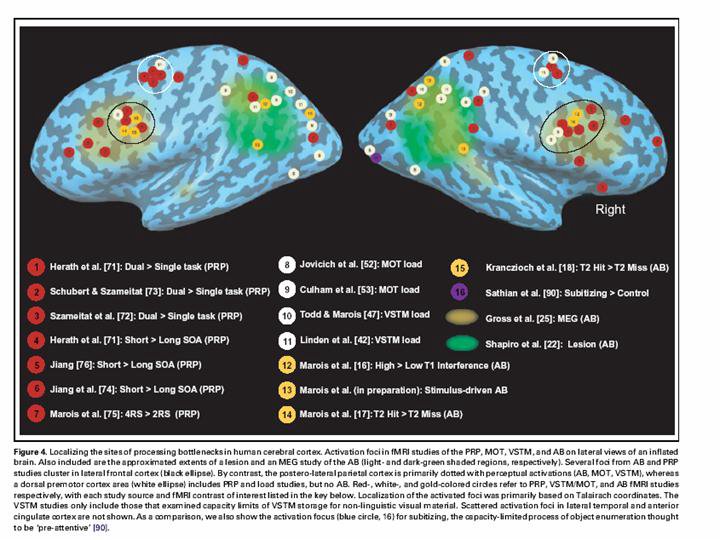
The abstract is posted below, plus some clarifying information from the introduction. The figure in this post represents the author neat attempt to summarize the research literature re: the areas of the brain associated with the three primary sources of the bottleneck (I like the way they graphically show the areas of the brain via the overlay of research study citations). If you double click on the image, your browser should present you with a larger more readable version.

Marois, R. & Ivanoff, J. (2005). Capacity limits of information processing in the brain Trends in Cognitive Sciences, 9(6), 296-305.

Abstract
  • Despite the impressive complexity and processing power of the human brain, it is severely capacity limited. Behavioral research has highlighted three major bottlenecks of information processing that can cripple our ability to consciously perceive, hold in mind, and act upon the visual world, illustrated by the attentional blink (AB), visual short-term memory (VSTM), and psychological refractory period (PRP) phenomena, respectively. A review of the neurobiological literature suggests that the capacity limit of VSTM storage is primarily localized to the posterior parietal and occipital cortex, whereas the AB and PRP are associated with partly overlapping fronto-parietal networks. The convergence of these two networks in the lateral frontal cortex points to this brain region as a putative neural locus of a common processing bottleneck for perception and action.
Additional information from the introduction
  • A rich history of cognitive research has highlighted three major processing limitations during the flow of information from sensation to action, each exemplified by a specific experimental paradigm. The first limitation concerns the time it takes to consciously identify and consolidate a visual stimulus in visual short-term memory (VSTM), as revealed by the attentional blink paradigm.This process can take more than half a second before it is free to identify a second stimulus.
  • A second, severely limited capacity is the restricted number of stimuli that can be held in VSTM, as exemplified by the change detection paradigm.
  • A third bottleneck arises when one must choose an appropriate response to each stimulus. Selecting an appropriate response for one stimulus delays by several hundred milliseconds the ability to select a response for a second stimulus (the‘psychological refractory period’).

Tuesday, May 03, 2005

Cognitive Efficiency and achievement

The following article, which is "in press" in Intelligence, provides interesting information regarding the potential importance of measures of cognitive efficiency in predicting/explaining school achievement. The abstract is printed below along with a few highlights from the study.

Luo, D., Thompson, L. A., & Detterman, D. K. (2005). The criterion validity of tasks of basic cognitive processes. Intelligence, In Press, Corrected Proof.

Abstract
  • The present study evaluated the criterion validity of the aggregated tasks of basic cognitive processes (TBCP). In age groups from 6 to 19 of the Woodcock-Johnson III Cognitive Abilities and Achievement Tests normative sample, the aggregated TBCP, i.e., the processing speed and working memory clusters, correlate with measures of scholastic achievement as strongly as the conventional indexes of crystallized intelligence and fluid intelligence. These basic processing aggregates also mediate almost exhaustively the correlations between measures of fluid intelligence and achievement, and appear to explain substantially more of the achievement measures than the fluid ability index. The results from the Western Reserve Twin Project sample using TBCP with more rigorous experimental paradigms were similar, suggesting that it may be practically feasible to adopt TBCP with experimental paradigms into the psychometric testing tradition. Results based on the latent factors in structural equation models largely confirmed the findings based on the observed aggregates and composites.
Summary/Comments
  • The measures of TBCP in the present study were taken from two data sources, Woodcock-Johnson III Cognitive Abilities and Achievement Tests (W-J III; Woodcock et al., 2001a, 2001c; Woodcock, McGrew, & Mather, 2001b) normative data and the Western Reserve Twin Project (WRTP) data. The WJ III results will be the focus of this post.
  • Luo et al. examined (via multiple regression and SEM) the extent to which measures of what the WJ III authors (myself included – see home page conflict of interest disclosure) call “cognitive efficiency” (CE - Gs and Gsm tests/clusters) add to the prediction of total achievement, above and beyond Gc and Gf.
  • These researchers found that CE measures/abilities demonstrated substantial correlations with scholastic performance (WJ III Total Achievement). The CE-Ach correlations were similar to correlations between conventional test composites and scholastic performance. These results suggested that measures of CE provide incremental predictive validity beyond Gc. Collectively, CE+Gc accounted for approximately about 60% of the variability in achievement when observed measures were analyzed (multiple regression) and up to 70% or more of the variance when the SEM latent traits were analyzed. The authors concluded that these levels of prediction were “remarkable”
  • Gf measures did NOT contribute significantly to the prediction of achievement beyond that already accounted for by the CE measures. [Editorial note – my prior research with the WJ III and WJ-R suggests this result may be due to the authors using “total achievement” as their criterion. My published research has consistently found that Gf is an important predictor/causal variable in the domain of mathematics].
  • A potential explanation for the power of the CE measures/variables has previously been published and posted to the web (click here).
  • The current results, IMHO, fit nicely within CHC-based information model frameworks that have been suggested. Simplified schematic models (based on the work of Woodcock) can be viewed by clicking here.