Showing posts with label multiple IQ. Show all posts

Thursday, May 21, 2026

Breaking legal and research news: SCOTUS (US Supreme Court) decision re multiple IQ scores in intellectual disability (ID) death penalty case (Hamm v Smith) - A DIG decision upholding the lower court decision

Today SCOTUS ruled on the Hamm v Smith multiple IQ score Atkins intellectual disability (ID) case that was argued before SCOTUS last December. This important decision, with all concurring and dissenting opinions, is available here.  Interested parties should read all the opinions. 

All documents and the history of the case can be found in a prior IQs Corner post.  As noted in the prior lengthy post, APA submitted an Amicus brief that, based on the reading of some of the justices opinions, suggests it (together with a AAIDD Amicus Brief) played an important role in the decision.


Briefly, when SCOTUS dismisses the writ of certiorari as improvidently granted it means the justices recognized that they made a mistake in agreeing to hear the case and decided to dismiss it without issuing a ruling on the merits. In legal shorthand, this is often referred to as a "DIG" (Dismissed as Improvidently Granted). This typically happens after the Court has accepted the case, reviewed the briefs, and sometimes even heard oral arguments. 

In practice, this means that the lower court decision—which is consistent with APA’s Amicus brief—that argued that multiple IQ scores should be viewed holistically  augmented by clinical judgement—stands. This means Mr. Smith will not be executed and, more importantly, the ruling does not upset the status of prior Atkins case law.  Given the recent direction and flavor of SCOTUS, there was a fear that SCOTUS might render a formal decision that would set back prior SCOTUS Atkins ID decisions.  So, this is a win for maintaining the principles of clinical judgement, the opinions and standards established by the established medical communities (both APA’s, AAIDD), and the need for a holistic approach to the interpretation of multiple IQ scores together with adaptive behavior.

A reading of the concurring opinions indicates that APA’s brief, as well as several key APA and AAIDD ID-related publications referenced in their decisions, were influential in the decision.  Several of the dissenting opinions reveal some troubling thinking by several justices. 
As a potential conflict of interest (COI) notice, I (Dr. Kevin McGrew), together with Dr. Joel Schneider and Dr. Cecil Reynolds (as noted on page three the APA amicus brief), were consultants to APA in the drafting of that brief.
It should be noted that as a result of the work of APA Amicus brief working committee, a peer-reviewed paper outlining a psychometrically sound approach (developed by Dr. Joel Schneider) for integrating multiple IQ scores was started during the deliberations and was recently published (Schneider, Reynolds, McGrew & Salekin, 2026) after the oral argument's.  This issue will likely to be revisited in future state cases, with Schneider et al. (2026) now elevated to a scientifically sound multiple IQ composite score method.

Friday, December 12, 2025

Hamm v Smith intellectual disability SCOTUS Atkins death penalty oral arguments (12-10-25) re multiple IQ scores: #ID #atkins #deathpenalty #IQ #intelligence


See prior post regarding Hamm v Smith Atkins ID death penalty case where central issue is how to handle multiple IQ scores.  All briefs are at that prior blog post page.

Oral arguments before the SCOTUS justices occurred this past Wednesday, 12-10-25.  One can download audio file (arguments lasted 2 hours) or transcript of arguments at this link

Sunday, December 07, 2025

Supreme Court to consider the role of #IQ tests in ban on executing people who are #intellectually disabled (#ID)- #SCOTUSblog: #schoolpsychology #schoolpsychologists #intelligence


An email quick-blog post FYI.
 
If you want more information, including amicus briefs for the defendent from professional groups (APA, AAIDD), visit a special post at IQs Corner blog—-
 
Court to consider the role of IQ tests in ban on executing people who are intellectually disabled - SCOTUSblog 
https://www.scotusblog.com/2025/12/court-to-consider-the-role-of-iq-tests-in-ban-on-executing-people-who-are-intellectually-disabled/

Pardon typos and spelling errors-Message may be sent from iPhone and I've always had spelling problems :)
 
 
*****************************************
Kevin S. McGrew, PhD
Educational & School Psychologist
Director
Institute for Applied Psychometrics (IAP)
https://www.themindhub.com
******************************************


Wednesday, October 08, 2025

IQs Corner. Comfortable fictions—The myth of #Gardner’s #multipleintelligences and other #educational fads (e.g., #learningstyles) - #schoolpsychology #schoolpsychologists #education #pseudoscience #intelligence

A thought provoking take at the Learning Dispatch (substack) re Gardner’s theory of multiple intelligences and other educational theories (e.g., learning styles) that appeal to comfortable fictions that “describe the reassuring stories societies tell to preserve moral comfort in the face of contradiction….these narratives about history, identity, and progress allow dominant groups to evade the moral costs of their own actions.


Thursday, September 25, 2025

IQs Corner. In what way are #intelligence testing (#IQ) and the US Supreme Court (#SCOTUS) alike?—SCOTUS will be hearing important case addressing #multiple IQ scores and #intellectualdisability #Dx in fall 2025 term

This fall 2025, the Supreme Court of the United States (SCOTUS) will be hearing a case related to intelligence testing in the context of Atkins intellectual disability (ID) death penalty cases. The case is Hamm v Smith.

The question before SCOTUS is :  Whether and how courts may consider the cumulative effect of multiple IQ scores in assessing Atkins claims (in the context of diagnosis ID in death penalty cases)?

Note.  In order to save space and time, instead of writing “general intelligence” or “general intellectual functioning” every time, I use the abbreviation “IQ”.

The respondent (Joseph Smith) has five IQ test scores from comprehensive IQ tests.  He obtained two scores of 75 and 74 during the developmental period (before age 22), and three scores of 72, 78, and 74 between the ages of 28 and 46.  

This case is important for assessment professionals who conduct intelligence testing in general, and potential ID diagnostic cases (Atkins cases in particular).  I find this SCOTUS case particularly interesting given that in 2021, after the 2021 release of the latest official AAIDD manual (Intellectual disability: Definition, diagnosis, classification, and systems of supports), I published a critique where I specifically stated, as one weakness of the new AAIDD manual that “…many high-stakes ID cases often include case files that include multiple IQ scores across time or from different IQ tests. Some form of guidance, at minimum in a passing reference, to the issues of the convergence of indicators and IQ score exchangeability would have been useful. Users will need to go beyond the AAIDD manual for guidance (see Floyd et al., 2021; McGrew, 2015; and Watson, 2015)” (click here to download and read this critique).

All official petitioner and respondent legal briefs (and amicus briefs) have now been published at the SCOTUS blog as of yesterday.  The number of documents posted on the SCOTUS docket are many.  To help the reader better determine which documents are most critical (the final briefs), instead of clicking away on the various links at the SCOUTUS blog, I’ve organized the petitioner and respondent brief links below.

If you prefer to not wade through all the briefs (it is not for everyone), I would encourage practicing assessment professionals read the three respondent-related briefs.  The points made are relevant to all who conduct intellectual assessments.  As a potential conflict of interest notice, I (Dr. Kevin McGrew), together with Dr. Joel Schneider and Dr. Cecil Reynolds (as noted on page three for the APA amicus brief), were consultants to APA in the drafting of that brief.  This work was performed pro bono. I, at a minimum, suggest reading all the respondent briefs.  If time permits, I would also suggest reading the petitioner’s Alabama brief and the US Justice Department Solicitor General’s brief to better understand the petitioner and respondent positions re Hamm v Smith. 

Petitioner briefs
  • The state of Alabama brief.  Alabama is the petitioner.  That is, if you want to read why the State of Alabama asked SCOTUS to hear this case, click on the link provided.
    • The Alabama brief also includes a very long appendix for those who want to read the prior courts related testimony from the state and various experts. This is a very long read and is not necessary for readers who only want to understand the legal and professional issues. 
  • Supporting amicus brief from the US Justice Department Solicitor General.
  • Two supporting briefs from legal groups—the American Legal Foundation and the Criminal Justice Legal Foundation.
  • Supporting amicus briefs from other states (Idaho et al.; Kentucky)

Respondent briefs
Final comment.  Those from school psychology should make note that we three consultants involved in drafting the APA/ApA,AL-APA brief all had our original educational roots in the profession of school psychology.  Furthermore, SP professionals should note the significant number of authoritative references to publications authored by school psychologists in the respondents briefs, as well as in some of the petitioners briefs.  I’ve been doing expert consultation, writing declarations, and testifying in court re: Atkins ID cases since 2009.  Joel Schneider and Cecil Reynolds have also been active in a similar capacity.  There are more psychologists who come from, or are affiliated with, the field of school psychology who have been prominent consultants/experts to lawyers and the courts re Atkins cases.  

Perhaps some of these briefs should be assigned readings (in intellectual assessment courses or special topic seminars) for graduate students being trained in the art and science of intelligence testing and interpretation.


Saturday, December 29, 2007

Howard Garnder slamed again--by Dr. "g" (Arthur Jensen)

There is little doubt that Howard Gardner, and his theory of multiple intelligences, has received considerable attention from the lay public and mass media. A trip to the psychology section of any Barnes and Nobles store always finds one staring at yet another book from this prolific scholar.

Unfortunately, IMHO, his work has received more attention than it deserves, while more serious empirically based research on the structure of intelligence (e.g., psychometrcally-based CHC theory) is ignored by the popular press and public. I understand many of the reasons for the differential treatment of these two different approaches, and will not delve into this controversy in this post. I've previously posted the essence of my thoughts re: Gardner's work--which I believe does have some heuristic merit if properly conceptualized (see my prior post for my ruminations)

I just skimmed Arthur "g" Jensen's review of the book (click here)--"Howard Gardner Under Fire: The Rebel Psychologist Faces His Critics)"

As one would expect, Jensen does not have many favorable comments regarding Gardner's work nor this supposed "critique" by others. Jensen feels that the reviewers who comment on Gardner's work were largely self-selected "like-minded" folks. The significant criticism that Jensen (and most other intelligence scholars from a more empirical/psychometric tradition) have for Gardner's work is captured in the following quote (from the review):
  • " Probably many educationists with little interest in acquiring a clear understanding of scientific psychology and psychometrics have uncritically embraced Gardner's psychology out of desperation. The persistent frustration of the educational system's dealing realistically with the wide range of scholastic aptitude in the nation's schools creates a fertile ground for seemingly attractive educational nostrums. Gardner's invention of the term “multiple intelligences” capitalizes on the high valuation the public accords to the word “intelligence.” The appeal of Gardner's terminology has been parodied as the Marie Antoinette theory of schooling: if the people have no bread, let them eat cake."
Technorati Tags: , , , , , , , , , , , , , , ,

Powered by ScribeFire.

Friday, January 05, 2007

Can IQ scores predict response to intervention? Guest post by John Garruto

The following is a guest post by John Garruto, school psychologist with the Oswego School District and member of the IQs Corner Virtual Community of Scholars. John reviewed the following article and has provided his comments below. [Blog dictator note - John's review is presented "as is" with only a few minor copy edits by the blog dicator and the insertion of some URL links]

Fuchs, D. & Young, C.L. (2006). On the Irrelevance of Intelligence in Predicting Responsiveness to Reading Instruction. Exceptional Children, 73(1), 8-30. (click here to view)

There has been considerable debate regarding the role of cognitive/intellectual assessment in the Response to Intervention (RTI) paradigm, primarily with regard to the identification of students with learning disabilities (LD). The purpose of this article was to review the relationship of IQ scores to performance in reading intervention program. Fuchs and Young reviewed 13 studies with somewhat mixed results. Below is my brief synopsis of their main conclusions:
  • Eight of the studies found IQ to be a significant correlate to reading. However, in many cases, fidelity of treatment was not always established.
  • The authors noted a modest ATI (Aptitude-Treatment-Interaction) relating to the importance of IQ to success with the type of treatment (for example, those with higher IQ’s tended to do better with decoding, fluency, and comprehension training, but IQ was less related to success in phonemic awareness training.)
  • Overall, Fuchs & Young, while conceding that IQ and a multi-factorial view of cognitive abilities are probably not as important to LD diagnosis as other proponents might espouse, there seems to be a role for the IQ test as part of the process of determining how to differentiate instruction.
An interesting twist in the article was the primarily focus on ‘g’, (or overall IQ; general intelligence), something that many cognitive processing theorists frown upon.. However, a closer examination of the dynamics of the studies reviewed might lead to some conclusions not stated in the paper. I offer the following observations and comments:
  • Fuchs and Young appropriately suggest that further investigations need to examine the relations between multi-factorial models of intelligence (e.g., CHC theory) and response-to-treatment interventions. They do concede that all of their studies use overall ‘g’ as a single predictor. However, a careful inspection reveals that most of the studies used the Wechsler batteries (WISC-III or earlier versions). If one examines the Olde School Wechsler…half of the test measures Verbal IQ or crystallized intelligence (Gc). There is a substantial body of literature relating crystallized intelligence (Gc) to reading ability.
  • None of the IQ tests included in the review measured auditory processing abilities (Ga), like those measured in the WJ III and specialized batteries (e.g., CTOPP). Therefore, it is not surprising that the authors found little relationship between intelligence tests and phonemic awareness training.
  • Cognitive ability tests have changed since the days of David Wechsler. We now know (and as Fuchs and Carlson highlight) that skills such as phonological processing (Ga-PC), rapid naming (Glr-NA), orthographic processing, etc. are important in learning to read. Although the Wechsler batteries do not assess these skills, there are cognitive ability tests that currently do. I would suggest that the relations between cognitive batteries that include measures of these important reading-related abilities would likely demonstrate stronger relations with intervention responsiveness. Of course, this is an empirical question begging further research.
  • Although Fuchs and Young do not necessarily espouse a multi-factorial model of intelligence for LD identification, clearly there are implications for a problem-solving model. If IQ (and let’s face it…IQ is predominantly Gc in the case of the Wechsler's) accounts for unique variance in predicting treatment outcome and explicit PA training is not related to IQ (but I would wager it would be related to auditory processing profiles), using CHC theory and CHC-designed batteries (e.g., WJ III; cross-battery designed assessments) seems to fit well within the context of this study. Other significant correlates to reading have been processing speed (Gs), short-term memory (Gsm), and long-term storage and retrieval (Glr). All of the above abilities are either underrepresented or not represented in the Wechsler batteries, the primary battery that served as the crux of this review.
  • The article recognizes and describes the two primary factions that are prominent in contemporary special education and school psychology fields--those who believe in response-to-intervention as the way to determine LD eligibility, and those who espouse the need for cognitive assessment. This article does not diminish the importance of RTI or the problem-solving model. In fact, it supports many of the changes noted in the regulations regarding the importance of RTI as a part LD determination process. It places importance on using empirically-based instruction and interventions. Fuchs and Young also highlight the significance of formative assessment and ongoing progress monitoring
Technorati Tags: , , , , , , , , , , , , , ,

powered by performancing firefox

Saturday, September 23, 2006

Howard Gardner's multiple intellignece (MI) theory again found wanting


Interesting post on the Gene Expression blog regarding recent study in journal of Intelligence that provides little support for Howard Garnder's MI theory. The less than positive comments/conclusions are not surprising to me. I first wrote about Gardner's MI theory back in 1993 and 1995. This material was subsequently incorporated into the Intelligence Test Desk References (ITDR), coauthored with Dr. Dawn Flanagan. Below is the what we wrote re: Gardner's MI theory in the ITDR.


The description of Gf-Gc theory as a multiple intelligences theory occasionally causes confusion when individuals try to reconcile this model with Gardner’s multiple intelligences theory (Chen & Gardner, 1997; Gardner, 1983, 1993, 1994). Although Gardner's theory of multiple intelligences has yet to serve as the foundation for an individually administered norm-referenced battery of tests, Gardner's concepts have received considerable attention in the popular press.

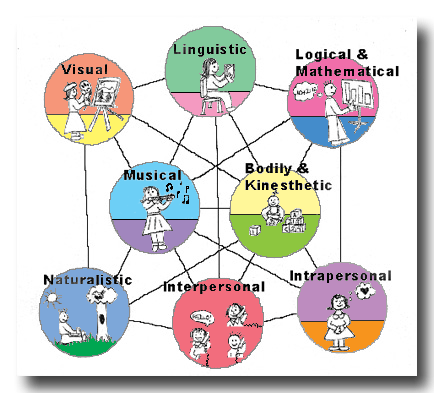
Gardner described seven types of intelligence, including logical-mathematical, linguistic, musical, spatial, bodily-kinesthetic, interpersonal, and intrapersonal. The terms Gardner uses to label his seven intelligences are dramatically different from the terminology of Gf-Gc theory. What are the differences and similarities between the Gf-Gc and Gardner multiple intelligences theories?

McGrew (1993, 1995) suggested that the fundamental differences between the two theories is that Gf-Gc theory is concerned with describing the basic domains or building blocks of intelligent behavior in the cognitive domain, while Gardner's theory focuses on how these different domains or building blocks are combined, together with other personal competencies (e.g., motor and social skills), in patterns representing different forms of aptitude or expertise (i.e., adult end-states valued by a culture) (Chen & Gardner, 1997). Using Greenspan’s model of personal competence (Greenspan & Driscoll, 1997) (a model that includes the broad domains of physical and emotional competence and conceptual, practical, and social intelligence) as an overarching framework, McGrew (1994) suggested that Gardner’s seven intelligences represent unique combinations or patterns of human cognitive abilities across domains of personal competence. For example, Gardner's logical-mathematical intelligence reflects a sensitivity to, and capacity for processing logical and/or numerical patterns, and the ability to manage long sequences or chains of reasoning. Scientists and mathematicians would most likely be high on logical-mathematical intelligence. An individual who has high logical-mathematical intelligence may have high fluid reasoning (Gf), quantitative knowledge (Gq), and visual processing abilities (Gv). It is the specific combination of Gf-Gc strengths that a person exhibits that defines him/her as being high in logical-mathematical intelligence. As another example, individuals who are high in Gardner’s bodily-kinesthetic intelligence may have specific Gf-Gc strengths (e.g., Gv), plus strengths in other personal competence domains such as physical competence.

In contrast to structural Gf-Gc theory, Gardner's theory of multiple intelligences focuses on a different aspect of human performance, namely, expertise or aptitude. Individuals with specific expertise or aptitudes likely have unique combinations of certain Gf-Gc abilities together with abilities in the other domains of personal competence. Gardner's theory is not an attempt to isolate the basic domains or elements of intelligence (a function performed by Gf-Gc theory), but rather, describes different patterns of expertise or aptitude based on specific combinations of Gf-Gc abilities and other personal competencies. In this regard, Gardner’s different intelligences are conceptually similar to Snow’s (1989, 1991, 1992) aptitude complexes that define aptitudes in the broadest sense (i.e., including both cognitive and conative structures).

Although Gardner’s theory has considerable appeal, it has been found wanting when subjected to empirical evaluation. In a review of Gardner’s (1983) Frames of Mind, the book that describes his Multiple Intelligences (MI) theory, Lubinski and Benbow (1995) conclude that there is “little empirical support for or against the unique features of Gardner’s ideas. Before MI theory can be taken seriously by the scientific community and policy makers, Gardner’s (1983) bold theoretical skeleton is in need of empirical flesh” (p. 937). According to Carroll (1993), Gardner “discounts multifactorial theories of intelligence...because, he claims, they fail to account for the full diversity of abilities that can be observed. Generally, Gardner has neglected the evidence on the basis of which the present three-stratum theory has been constructed” (p. 641). Furthermore, in a review and comparison of structural Gf-Gc theory, Gardner’s Multiple Intelligences theory, and Sternberg’s Triarchic theory (Sternberg, 1997), Messick (1992) characterized Gardner’s (as well as Sternberg’s) theory as appealing selectively to factor analytic research and ignoring or downplaying factor analytic research that challenges his model. Thus, it seems clear that the descriptions of Gardner’s seven multiple intelligences “do not derive from any consistent set of empirical data and can be tied to data only in piecemeal fashion, thereby being constantly threatened by the perverse human tendency to highlight results that are consonant with the theory’s logic over findings that are dissonant” (Messick, 1992; p. 368). Bouchard (1984), Scarr (1985), and Snow (1985) also questioned the empirical support for Gardner’s theory.


Technorati Tags: , , , , , , , , , , , , ,

powered by performancing firefox