Showing posts with label Gt. Show all posts

Saturday, July 14, 2018

Using Gt distribution parameters to predict executive functions in AHDH: Study consistent with Schneider & McGrew 2018 CHC update chapter

Interesting article consistent with what Joel Schneider and I discussed in our latest CHC Intelligence theory update chapter. Click here for info.

Using inspection time and ex-Gaussian parameters of reaction time to predict executive functions in children with ADHD. Intelligence, 69 (2018) 186–194.

Hilary Galloway-Long, Cynthia Huang-Pollock


A B S T R A C T

Slower and more variable performance in speeded reaction time tasks is a prominent cognitive signature among children with Attention Deficit Hyperactivity Disorder (ADHD), and is often also negatively associated with executive functioning ability. In the current study, we utilize a visual inspection time task and an ex-Gaussian decomposition of the reaction time data from the same task to better understand which of several cognitive subprocesses (i.e., perceptual encoding, decision-making, or fine-motor output) may be responsible for these important relationships. Consistent with previous research, children with ADHD (n = 190; 68 girls) had longer/ slower SD and tau than non-ADHD peers (n = 76; 42 girls), but there were no group differences in inspection time, mu, or sigma. Smaller mu, greater sigma, longer tau, and slower inspection time together predicted worse performance on a latent executive function factor, but only tau partially mediated the relationship between ADHD symptomology and EF. These results suggest that the speed of information accumulation during the decision-making process may be an important mechanism that explains ADHD-related deficits in executive control.

Click image to enlarge.


Assessment Recommendations for Gt (from Schneider & McGrew, 2018)

To be published shortly in:


Tasks measuring Gt are not typically used in clinical settings (except perhaps in CPTs). With the increasing use of low-cost mobile computing devices (i.e., smartphones and iPads/other slate notebook computers), we predict that practical measures of Gt will soon be available for clinical use. Some potential clinical applications are already apparent. We present three examples.

Gregory, Nettelbeck, and Wilson (2009) demonstrated that initial level of and rate of changes in inspection time might serve as an important biomarker of aging. Briefly, a biomarker for the aging process “is a biological parameter, like blood pressure or visual acuity that measures a basic biological process of ageing and predicts later functional capabilities more effectively than can chronological age . . . a valid biomarker should predict a range of important age-related outcomes including cognitive functioning, everyday independence and mortality, in that order of salience” (p. 999). In a small sample of elderly individuals, initial inspection time level and rate of slowing (over repeated testing) was related to cognitive functioning and everyday competence. Repeated, relatively low-cost assessment of adults' inspection times might serve a useful function in cognitive aging research and serve as a routine measure (much like blood pressure) to detect possible early signs of cognitive decline.

Researchers have demonstrated how to harness the typical non-normal distributions of RT as a potential aid in diagnosis of certain clinical disorders. Most RT response distributions are not normally distributed in the classic sense. They are virtually always positively skewed, with most RTs falling at the faster end of the distribution. These distributions are called ex-Gaussian, which is a mathematical combination of Gaussian and exponential distributions. It can be characterized by the mean (m), the standard deviation (s),and an exponential function (t) that reflects the mean and standard deviation exponential component (Balota & Yap, 2011). (Don't worry; one does not need to under-stand this statistics-as-a-second-language brief description to appreciate the potential application.) The important finding is that “individuals carry with them their own characteristic RT distributions that are relatively stable over time” (p. 162). Thus, given the ease an efficiency with which RT tests could be repeatedly administered to individu-als (via smart devices and portable computers), it would be possible to readily obtain each person's RT distribution signature. Of most importance is the finding that all three RT distribution parameters are relatively stable, and t is very stable (e.g., test–retest correlations in the high .80s to low .90s). Furthermore, there is a robust relation between t and working memory performance that is consistent with the worst-performance rule (WPR) discovered in the intelligence literature. The WPR states that on repeated trial testing on cognitive tasks, the trials where a person does poorest (worst) are better predictors of intelligence than the best-performance trials (Coyle, 2003). It has been demonstrated, in keeping with the WPR, that the portion of each person's RT distribution representing the slowest RTs is strongly related to fluid intelligence and working memory.

In the not-too-distant future, assessment personal armed with portable smart devices or computers could test an individual repeatedly over time with RT paradigms. Then, via magical software or app algorithms, a person's RT distribution signature could be obtained (and compared against the normative distribution) to gain insights into the person's general intelligence, Gf, or working memory over time. This could have im-portant applications in monitoring of age-related cognitive changes, responses to medication for attention-deficit/hyperactivity disorder (ADHD) or other disorders, the effectiveness of brain fitness programs, and so forth. Finally, using the same general RT paradigms and metrics, research has indicated that it may be possible to differentiate children with ADHD from typically developing children (Kofler et al., 2013) and children with ADHD from those with dyslexia (Gooch, Snowling, & Hulme, 2012), based on the RT variability—not the mean level of performance. It is also possible that RT variability might simply be a general marker for a number of underlying neurocognitive disorders.

We have the technology. We have the capability to build portable, low-cost assessment technology based on Gt assessment paradigms. With more efficient and better assessments than before, build it . . . and they (assessment professionals) will come.


- Posted using BlogPress from my iPad

Thursday, April 26, 2018

Practice effects and progressive error practice effects on speeded tests

Journal of Intelligence

Response Time Reduction Due to Retesting in Mental Speed Tests: A Meta-Analysis (article link)

Jana Scharfen, Diego Blum and Heinz Holling


Abstract

As retest effects in cognitive ability tests have been investigated by various primary and meta-analytic studies, most studies from this area focus on score gains as a result of retesting. To the best of our knowledge, no meta-analytic study has been reported that provides sizable estimates of response time (RT) reductions due to retesting. This multilevel meta-analysis focuses on mental speed tasks, for which outcome measures often consist of RTs. The size of RT reduction due to retesting in mental speed tasks for up to four test administrations was analyzed based on 36 studies including 49 samples and 212 outcomes for a total sample size of 21,810. Significant RT reductions were found, which increased with the number of test administrations, without reaching a plateau. Larger RT reductions were observed in more complex mental speed tasks compared to simple ones, whereas age and test-retest interval mostly did not moderate the size of the effect. Although a high heterogeneity of effects exists, retest effects were shown to occur for mental speed tasks regarding RT outcomes and should thus be more thoroughly accounted for in applied and research settings.

Keywords: meta-analysis; mental speed; processing speed; retest effect; practice effect; response time; reaction time; automatization


- Posted using BlogPress from my iPad

Friday, November 17, 2017

CHC theory evolution: Processing speed-Gs

Click on images to enlarge


- Posted using BlogPress from my iPad

Friday, November 10, 2017

Research Byte: Is General Intelligence Little More Than the Speed of Higher-Order Processing?

Although a small sample, this is still and interesting study. The results are consistent with the continued nexus of the g, Gf, Gwm, attentional control and speed of higher order processing (especially P300 in ERP’s), white matter tract integrity and the PFIT model of intelligence as well as the recent process overlap theory (POT) of g.

Click on images to enlarge


Article link.

Anna-Lena Schubert, Dirk Hagemann, and Gidon T. Frischkorn Heidelberg University

ABSTRACT

Individual differences in the speed of information processing have been hypothesized to give rise to individual differences in general intelligence. Consistent with this hypothesis, reaction times (RTs) and latencies of event-related potential have been shown to be moderately associated with intelligence. These associations have been explained either in terms of individual differences in some brain-wide property such as myelination, the speed of neural oscillations, or white-matter tract integrity, or in terms of individual differences in specific processes such as the signal-to-noise ratio in evidence accumulation, executive control, or the cholinergic system. Here we show in a sample of 122 participants, who completed a battery of RT tasks at 2 laboratory sessions while an EEG was recorded, that more intelligent individuals have a higher speed of higher-order information processing that explains about 80% of the variance in general intelligence. Our results do not support the notion that individuals with higher levels of general intelligence show advantages in some brain-wide property. Instead, they suggest that more intelligent individuals benefit from a more efficient transmission of information from frontal attention and working memory processes to temporal-parietal processes of memory storage.

Keywords: ERP latencies, event-related potentials, intelligence, processing speed, reaction times


- Posted using BlogPress from my iPad

Saturday, January 16, 2016

Tuesday, July 24, 2012

Research byte: Study suggests Gt and Gs from single factor--and some task specific speed factors

Study that challenges the distinction between Gt (reaction time mental speed) and general cognitive processing speed (Gs)

Click on images to enlarge


Posted using BlogPress from Kevin McGrew's iPad
www.themindhub.com

Monday, October 10, 2011

Research byte: Reaction time (Gt) and the VPR model of intelligennce

Wendy Johnson continues to pump out articles regarding the VPR model of intelligence. The one highlighted below investigates the relations between Gt (reaction time abilities) and the primary domains of the VPR model. Double click on images to enlarge.


- iPost using BlogPress from Kevin McGrew's iPad

Wednesday, September 21, 2011

Mad Box reaction time app: Possible brain fitness tool?

An interesting reaction time app for the iPhone/iPad. It has the appearance of a possible brain fitness tool......would be nice someone would do some research on this to see if it does improve any aspects of cognitive functioning

Double click on image to enlarge. Visit link about to visit developers website


- iPost using BlogPress from Kevin McGrew's iPad

Tuesday, June 07, 2011

Research Byte: Mental chronometry response time distributions

Double click image to enlarge


- iPost using BlogPress from my Kevin McGrew's iPad

Monday, May 02, 2011

Wednesday, January 12, 2011

Human processing speed: A hierarchical multidimensional model with g-speed at the apex?

There is an active thread on the NASP (National Association of School Psychologists) listerv this morning re: what is the nature of "processing speed" (Gs as per CHC theory).  Coincidentally, the past few days I have been writing on the psychometric research re: the domain of human cognitive speedDr. Joel Schneider and I are working on a CHC theory chapter manuscript, and this is proposed to be in the chapter.

Related to the text is the following proposed hierarchical model of cognitive speed...which suggests that psychologists need to understand that it may be a much more complex domain with it's own hierarchy and g-type (g-speed) factor at the apex.  The figure below was first included in McGrew and Evan's (2004), where the hierarchy was first proposed.  Joel Schneider has worked his excellent Gv PPT expertise and produced this much prettier version.  Click here and you will see the image from the web page server.

In addition to the more thorough treatment in the McGrew & Evans (2004) document, the following draf text may be useful (Schneider & McGrew, book chapter manuscript in preparation).

Of particular interest, but largely ignored during the past five years, was the conclusion that the speed domains of Gs and Gt might best be represented within the context of a hierarchically organized speed taxonomy with a g-speed factor at the apex (McGrew, 2004; McGrew & Evans, 2004).  This conclusion is echoed by Danthiir, Roberts, Schulze and Wilhelm (2005), who after conducting much of the research that suggests a multidimensional speed hierarchy, suggested that “one distinct possibility is that mental speed tasks form as complex a hierarchy as level (i.e., accuracy) measures from psychometric tasks, with a general mental speed factor at the apex and broad factors of mental speed forming a second underlying tier” (p. 32).  McGrew and Evan’s (2004) hypothesized hierarchy of speed abilities is formally published here for the first time in Figure X


Technorati Tags: , , , , , , , , , , ,

Wednesday, November 03, 2010

Research bytes: Inconsistency (and not level) in reaction time (Gt) may predict adult cognitive decline


Intraindividual variability in reaction time predicts cognitive outcomes 5 years later, 2010 Volume 24, Issue 6 (Nov), Neuropsychology, Pages 731-741. Bielak, Allison A. M.; Hultsch, David F.; Strauss, Esther; MacDonald, Stuart W. S.; Hunter, Michael A.

Abstract

Objective: Building on results suggesting that intraindividual variability in reaction time (inconsistency) is highly sensitive to even subtle changes in cognitive ability, this study addressed the capacity of inconsistency to predict change in cognitive status (i.e., cognitive impairment, no dementia [CIND] classification) and attrition 5 years later. Method: Two hundred twelve community-dwelling older adults, initially aged 64–92 years, remained in the study after 5 years. Inconsistency was calculated from baseline reaction time performance. Participants were assigned to groups on the basis of their fluctuations in CIND classification over time. Logistic and Cox regressions were used. Results: Baseline inconsistency significantly distinguished among those who remained or transitioned into CIND over the 5 years and those who were consistently intact (e.g., stable intact vs. stable CIND, Wald (1) = 7.91, p < .01, Exp(β) = 1.49). Average level of inconsistency over time was also predictive of study attrition, for example, Wald (1) = 11.31, p < .01, Exp(β) = 1.24. Conclusions: For both outcomes, greater inconsistency was associated with a greater likelihood of being in a maladaptive group 5 years later. Variability based on moderately cognitively challenging tasks appeared to be particularly sensitive to longitudinal changes in cognitive ability. Mean rate of responding was a comparable predictor of change in most instances, but individuals were at greater relative risk of being in a maladaptive outcome group if they were more inconsistent rather than if they were slower in responding. Implications for the potential utility of intraindividual variability in reaction time as an early marker of cognitive decline are discussed. (PsycINFO Database Record (c) 2010 APA, all rights reserved)


- iPost using BlogPress from my Kevin McGrew's iPad

Thursday, May 27, 2010

iPost: Processing speed (Gs/Gt as per CHC theory) and children with CP


Inspection time and attention-deficit/hyperactivity disorder symptoms in children with cerebral palsy.
By Shank, Laura K.; Kaufman, Jacqueline; Leffard, Stacie; Warschausky, Seth
Rehabilitation Psychology, Vol 55(2), May 2010, 188-193.
Abstract

Objective: To examine between-groups differences in the associations between aspects of processing speed assessed with an inspection time task and attention-deficit/hyperactivity disorder (ADHD) symptoms. Research Design: Two groups comprising 34 children with cerebral palsy (CP) and 70 nonaffected peers (control), ages 8–16 years, participated in a prospective correlational study. Measures included a visual inspection time task and the Conners' Parent Rating Scale—Revised: Long Version. Results: Children with CP exhibited significantly slower processing speed and more symptoms of inattention and hyperactivity than controls. Significant associations between inspection time and ADHD symptoms were found only in the control group. Conclusions: Findings have implications for clinical assessment and understanding of attentional risks associated with CP. (PsycINFO Database Record 

Tuesday, November 24, 2009

Dissertation dish: New insights on the subdomains of Gs (processing speed)


Exploring the relationships among various measures of processing speed in a sample of children referred for psychological assessments by Nelson, Megan A., Ph.D., University of Virginia, 2009 , 102 pages; AAT 3348732

Abstract

Processing speed is a robust psychometric factor in modern tests of cognitive ability (Carroll, 1993), but the common factors underlying mental speed and its contributions to individual differences in functioning are not well understood. The goal of the current study was to further explore mental speed by conducting a confirmatory factor analysis (CFA) on 11 speeded subtest scores. It was hypothesized that the 11 subtests would be best represented by a four-factor model. These four factors were then submitted to a cluster analysis to identify whether certain patterns of factor scores were related to different demographic characteristics, diagnoses, or referral questions. It was hypothesized that Learning Disorder, Attention-Deficit/Hyperactive Disorder, and comorbid LD/ADHD diagnoses would be most likely to have unique processing speed factor patterns.

Participants were 186 children (ages 6 - 18 years old) referred to a university-based clinic for a comprehensive psychological evaluation. The CFA indicated that although the 11 measures are all speeded, they are best represented as four distinct constructs, labeled perceptual speed, naming facility, academic facility, and reaction time in this study. The clusters produced in this study appeared to be most highly differentiated by level (likely influenced by intelligence level) and by pattern only in respect to reaction time factor scores. Therefore, both the CFA and cluster analyses lend support to Cattell-Horn-Carroll cognitive theory's distinction between cognitive processing speed (Gs) and decision/reaction time (Gt). Additionally, the CFA results suggest that Gs may be multifaceted, but the cluster analysis did not differentiate clusters based on the processing speed factors. Although the results of this study have important implications for both assessment clinicians and cognitive theory, further research is needed to clarify the constructs of processing speed and reaction time as well as to identify the clinical implications of different processing speed pattern
s

Technorati Tags: , , , , , , , , , , , , , , ,


Wednesday, March 11, 2009

CHC intelligence definitions: "Official" table (for now)


In 1997, as part of a book chapter I wrote for Flanagan et al's 1997 CIA book, I developed a table of Cattell-Horn-Carroll cognitive ability definitions (CHC Theory; back then called Extended Gf-Gc theory), which I extracted from Carroll's (1993) seminal treatise. As described in that chapter, Jack Carroll was gracious enough to review and make suggestions via an iterative back-and-forth process...eventually blessing that 1997 table.

Since then this table of broad and narrow CHC definitions has more-or-less become the "official" set of working definitions and has surfaced in most CHC publications.

Since then I've worked to refine these definitions. Part of the refinement process has been seeking feedback from other professionals. I've recently revised the table as it will be used by all authors in a forthcoming special issue on CHC theory and assessment in a school psychology journal.

Today I'm announcing the latest (and greatest) revision of CHC broad and narrow ability definitions. Consider it a "working list" that will undergoe revision as additional research accumulates and additional feedback is received.

A copy can be viewed/downloaded by clicking here.

Technorati Tags: , , , , , , , , , , , , , , , , , , , , , , , , , , , ,

Wednesday, December 17, 2008

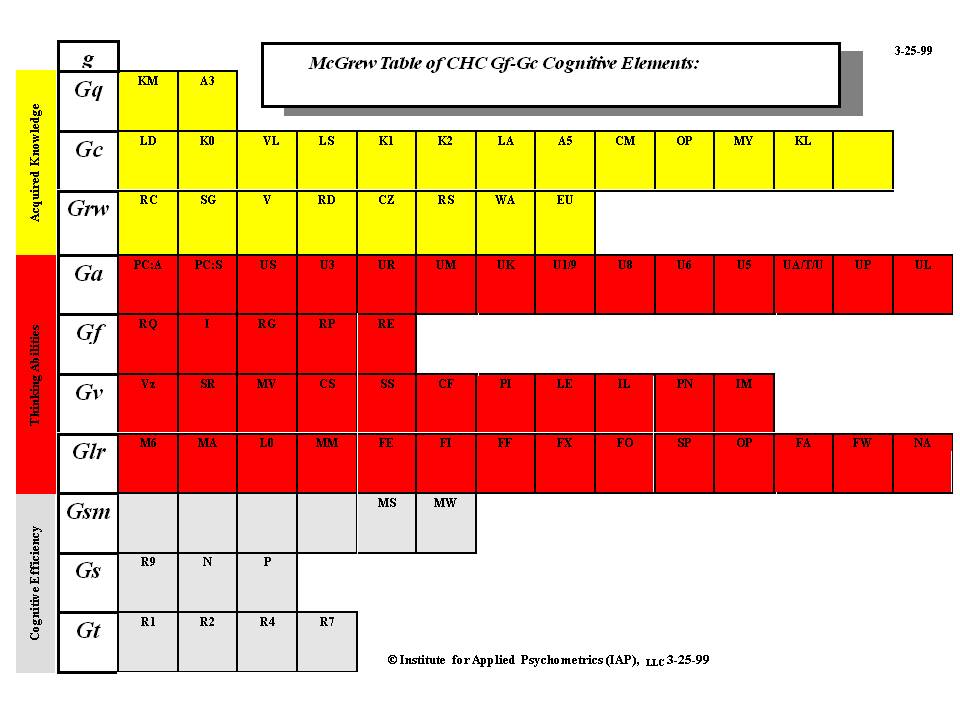
CHC Periodic Table of Cognitive Elements: Back by popular demand


[double click on image to enlarge]

I frequently get requests for a figure I constructed in 1999. It was the McGrew CHC Gf-Gc Periodic Table of Cognitive Elements. I had been unable to locate the original, but today stumbled across it. A .jpeg copy can be viewed and downloaded by clicking here.

I'm thinking of updating this into something more special..possibly an on-line clickable figure that would take viewers to definitons and additional information re: the various abilities represented.

Good old ideas never die...they sometimes just get lost on hard drives.

Technorati Tags: , , , , , , , , , , ,

Friday, November 14, 2008

Processing speed (Gs) measures = sustained attention measures ?


[Double click on image to enlarge]

Do processing speed (Gs) measures = sustained attention (SA) measures?

According to a recent CFA study of 199 college students, traditional paper-and-pencil measures of broad cognitive speed (Gs) and sustained attention (SA) may not be measuring different constructs given the shared speeded performance constraint. However, broad decision speed (Gt), as measured by computerized tests, does appear to represent a construct separate from Gs/SA--although the difference could be related to method factor variance (paper/pencil vs computer).

According to Krumm et al. (2008), SA and Gs (which they refer to as mental speed-MS) are theoretically conceptualized to represent distinct constructs. "Individual difference research has always distinguished between MS and SA measures (see Stankov, 1988)."

"Sustained attention (SA) may be defined as the 'ability to allocate processing resources for quite a time (up to some minutes) to a specific task demand while ignoring new stimuli that also demand attention' (Schweizer, 2005, p. 46). Similarly, Hoffmann (1993) describes SA as the ability to devotedly apply oneself to a task while ignoring distractions."

The authors point out that although SA and Gs are conceptually distinct cognitive constructs, they are typically assessed with very similar tasks--simple cognitive tasks where "performance largely relies on the participants’ speed of task processing (i.e., how quickly and correctly one can perform the simple cognitive tasks)."

The CFA results found a near unity (.97) correlation between SA and Gs (see figure above).

It is suggested that clinicians and researchers may need to pursue new approaches to differentiating the measurement of SA and Gs. Furthermore, these findings suggest that the clinical interpretation of Gs tests on individually administered intelligence batteries may be confounded by sustained attention. Most clinicians and books on intelligence test interpretation have typically made this point---and have suggested that sustained attention may be measured by tests that typically are interpreted to measure Gs-like abilities---e.g., perceptual speed (P). It is possible that sustained attention may play a larger role on traditional paper-and-pencil tests than previously recognized.

Of course, caveats are necessary. This study is limited to a young adult age range and 199 subjects. It would be nice to see simlar studies across the entire age range.

Krumm, S, Schmidt-Atzert, L., Michalczyk, K. & Danthiir, V. (2008). Speeded Paper-Pencil Sustained Attention and Mental Speed Tests: Can Performances Be Discriminated?J ournal of Individual Differences, 29,p. 205–216

  • Abstract. Mental speed (MS) and sustained attention (SA) are theoretically distinct constructs. However, tests of MS are very similar to SA tests that use time pressure as an impeding condition. The performance in such tasks largely relies on the participants’ speed of task processing (i.e., how quickly and correctly one can perform the simple cognitive tasks). The present study examined whether SA and MS are empirically the same or different constructs. To this end, 24 paper-pencil and computerized tests were administered to 199 students. SA turned out to be highly related toMS task classes: substitution and perceptual speed. Furthermore, SA showed a very close relationship with the paper-pencil MS factor. The correlation between SA and computerized speed was considerably lower but still high. In a higher-order general speed factor model, SA had the highest loading on the higher-order factor; the higher-order factor explained 88% of SA variance. It is argued that SA (as operationalized with tests using time pressure as an impeding condition) and MS cannot be differentiated, at the level of broad constructs. Implications for neuropsychological assessment and future research are discussed.

Technorati Tags: , , , , , , , , , , ,

Friday, June 20, 2008

Jensen's Clocking the Mind: Another book review


I've previously posted two reviews of Arthur Jensen's "Clocking the Mind" book. I just found a third review (click here to view). Readers now have three different reviews of this high profile book in the field of intelligence research.

Technorati Tags: , , , , , , , , , , ,