Showing posts with label Gardner. Show all posts

Wednesday, October 08, 2025

IQs Corner. Comfortable fictions—The myth of #Gardner’s #multipleintelligences and other #educational fads (e.g., #learningstyles) - #schoolpsychology #schoolpsychologists #education #pseudoscience #intelligence

A thought provoking take at the Learning Dispatch (substack) re Gardner’s theory of multiple intelligences and other educational theories (e.g., learning styles) that appeal to comfortable fictions that “describe the reassuring stories societies tell to preserve moral comfort in the face of contradiction….these narratives about history, identity, and progress allow dominant groups to evade the moral costs of their own actions.


Sunday, December 19, 2010

IQ tests and theory trends: Google Ngram visualizations

This past week I read a very intriguing article in the New York Times about a new data visualization tool offered by Google-- the Google Books Ngram Viewer. I then ran across a legal blog post where someone had investigated trends in different law terms...and I couldn't help myself but to give it a try.

As described by Robert Ambrogi at the legal blog:

"Using data drawn from the millions of books it has digitized covering the years 1500 to 2008, it lets you see and compare the frequency of words and phrases as they were used in books over a span of years or centuries. As Google puts it: “The Ngram Viewer lets you graph and compare phrases from these datasets over time, showing how their usage has waxed and waned over the years.”

I first had to experiment with how the entered terms worked. The terms are case sensitive. I checked each phrase with a variety of permutations to maximum the "hit rate"...and then ran some phrases together to ascertain and compare trends.

Below are my results with a few comments--the data tend to speak for themselves. I found that most of what I searched for did not emerge until after 1940...so that is where each graph starts. It is also important to note that the graphs only go up thru 2008...it would be nice to see the graphs up today

Cool stuff. Double click on each graph to enlarge.


This chart suggests that the cognitive ability domains of Gv (Visual Processing), Ga (Auditory Processing), and Processing Speed (Gs) have become hotter topics than Gf (Fluid Intelligence), Gc (Crystallized Intelligence), Gsm (Short term Memory), and Glr (Long term Retrieval). Interesting.


One very clear observation. Among the non-Wechsler intelligence batteries, the Stanford Binet has dropped dramatically over time, while the "newbies" on the IQ testing block (WJ, DAS, KABC, CAS) have made been the focus of more writing since 1990. Note, "Wechsler Intelligence", when included, is the clear winner across time. I left it out so the trends for the "other" batteries would be more distinct.


As I have written about many times, contemporary Cattell-Horn-Carroll (CHC) intelligence theory has become the consensus theory of intelligence. This interesting graph supports this conclusion, especially from 1997 to 2008. Also, if one clicks on the search term in the summary table, one is taken to a page of the Google books that included the term. Click here to see example for CHC theory.

I think many of the trends noted above are due to emergence of Gf-Gc theory to CHC theory with the publication of the 1989 WJ-R. I've written about this critical theory-to-practice birth period here and here.

- iPost using BlogPress from my Kevin McGrew's iPad

Saturday, December 29, 2007

Howard Garnder slamed again--by Dr. "g" (Arthur Jensen)

There is little doubt that Howard Gardner, and his theory of multiple intelligences, has received considerable attention from the lay public and mass media. A trip to the psychology section of any Barnes and Nobles store always finds one staring at yet another book from this prolific scholar.

Unfortunately, IMHO, his work has received more attention than it deserves, while more serious empirically based research on the structure of intelligence (e.g., psychometrcally-based CHC theory) is ignored by the popular press and public. I understand many of the reasons for the differential treatment of these two different approaches, and will not delve into this controversy in this post. I've previously posted the essence of my thoughts re: Gardner's work--which I believe does have some heuristic merit if properly conceptualized (see my prior post for my ruminations)

I just skimmed Arthur "g" Jensen's review of the book (click here)--"Howard Gardner Under Fire: The Rebel Psychologist Faces His Critics)"

As one would expect, Jensen does not have many favorable comments regarding Gardner's work nor this supposed "critique" by others. Jensen feels that the reviewers who comment on Gardner's work were largely self-selected "like-minded" folks. The significant criticism that Jensen (and most other intelligence scholars from a more empirical/psychometric tradition) have for Gardner's work is captured in the following quote (from the review):
  • " Probably many educationists with little interest in acquiring a clear understanding of scientific psychology and psychometrics have uncritically embraced Gardner's psychology out of desperation. The persistent frustration of the educational system's dealing realistically with the wide range of scholastic aptitude in the nation's schools creates a fertile ground for seemingly attractive educational nostrums. Gardner's invention of the term “multiple intelligences” capitalizes on the high valuation the public accords to the word “intelligence.” The appeal of Gardner's terminology has been parodied as the Marie Antoinette theory of schooling: if the people have no bread, let them eat cake."
Technorati Tags: , , , , , , , , , , , , , , ,

Powered by ScribeFire.

Saturday, September 23, 2006

Howard Gardner's multiple intellignece (MI) theory again found wanting


Interesting post on the Gene Expression blog regarding recent study in journal of Intelligence that provides little support for Howard Garnder's MI theory. The less than positive comments/conclusions are not surprising to me. I first wrote about Gardner's MI theory back in 1993 and 1995. This material was subsequently incorporated into the Intelligence Test Desk References (ITDR), coauthored with Dr. Dawn Flanagan. Below is the what we wrote re: Gardner's MI theory in the ITDR.


The description of Gf-Gc theory as a multiple intelligences theory occasionally causes confusion when individuals try to reconcile this model with Gardner’s multiple intelligences theory (Chen & Gardner, 1997; Gardner, 1983, 1993, 1994). Although Gardner's theory of multiple intelligences has yet to serve as the foundation for an individually administered norm-referenced battery of tests, Gardner's concepts have received considerable attention in the popular press.

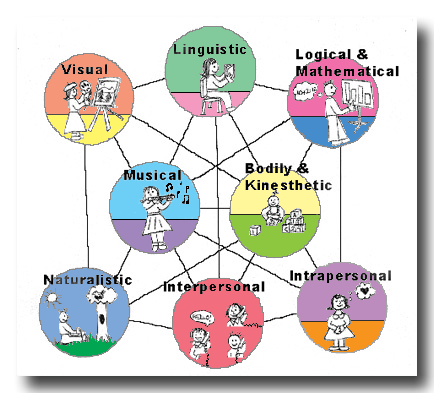
Gardner described seven types of intelligence, including logical-mathematical, linguistic, musical, spatial, bodily-kinesthetic, interpersonal, and intrapersonal. The terms Gardner uses to label his seven intelligences are dramatically different from the terminology of Gf-Gc theory. What are the differences and similarities between the Gf-Gc and Gardner multiple intelligences theories?

McGrew (1993, 1995) suggested that the fundamental differences between the two theories is that Gf-Gc theory is concerned with describing the basic domains or building blocks of intelligent behavior in the cognitive domain, while Gardner's theory focuses on how these different domains or building blocks are combined, together with other personal competencies (e.g., motor and social skills), in patterns representing different forms of aptitude or expertise (i.e., adult end-states valued by a culture) (Chen & Gardner, 1997). Using Greenspan’s model of personal competence (Greenspan & Driscoll, 1997) (a model that includes the broad domains of physical and emotional competence and conceptual, practical, and social intelligence) as an overarching framework, McGrew (1994) suggested that Gardner’s seven intelligences represent unique combinations or patterns of human cognitive abilities across domains of personal competence. For example, Gardner's logical-mathematical intelligence reflects a sensitivity to, and capacity for processing logical and/or numerical patterns, and the ability to manage long sequences or chains of reasoning. Scientists and mathematicians would most likely be high on logical-mathematical intelligence. An individual who has high logical-mathematical intelligence may have high fluid reasoning (Gf), quantitative knowledge (Gq), and visual processing abilities (Gv). It is the specific combination of Gf-Gc strengths that a person exhibits that defines him/her as being high in logical-mathematical intelligence. As another example, individuals who are high in Gardner’s bodily-kinesthetic intelligence may have specific Gf-Gc strengths (e.g., Gv), plus strengths in other personal competence domains such as physical competence.

In contrast to structural Gf-Gc theory, Gardner's theory of multiple intelligences focuses on a different aspect of human performance, namely, expertise or aptitude. Individuals with specific expertise or aptitudes likely have unique combinations of certain Gf-Gc abilities together with abilities in the other domains of personal competence. Gardner's theory is not an attempt to isolate the basic domains or elements of intelligence (a function performed by Gf-Gc theory), but rather, describes different patterns of expertise or aptitude based on specific combinations of Gf-Gc abilities and other personal competencies. In this regard, Gardner’s different intelligences are conceptually similar to Snow’s (1989, 1991, 1992) aptitude complexes that define aptitudes in the broadest sense (i.e., including both cognitive and conative structures).

Although Gardner’s theory has considerable appeal, it has been found wanting when subjected to empirical evaluation. In a review of Gardner’s (1983) Frames of Mind, the book that describes his Multiple Intelligences (MI) theory, Lubinski and Benbow (1995) conclude that there is “little empirical support for or against the unique features of Gardner’s ideas. Before MI theory can be taken seriously by the scientific community and policy makers, Gardner’s (1983) bold theoretical skeleton is in need of empirical flesh” (p. 937). According to Carroll (1993), Gardner “discounts multifactorial theories of intelligence...because, he claims, they fail to account for the full diversity of abilities that can be observed. Generally, Gardner has neglected the evidence on the basis of which the present three-stratum theory has been constructed” (p. 641). Furthermore, in a review and comparison of structural Gf-Gc theory, Gardner’s Multiple Intelligences theory, and Sternberg’s Triarchic theory (Sternberg, 1997), Messick (1992) characterized Gardner’s (as well as Sternberg’s) theory as appealing selectively to factor analytic research and ignoring or downplaying factor analytic research that challenges his model. Thus, it seems clear that the descriptions of Gardner’s seven multiple intelligences “do not derive from any consistent set of empirical data and can be tied to data only in piecemeal fashion, thereby being constantly threatened by the perverse human tendency to highlight results that are consonant with the theory’s logic over findings that are dissonant” (Messick, 1992; p. 368). Bouchard (1984), Scarr (1985), and Snow (1985) also questioned the empirical support for Gardner’s theory.


Technorati Tags: , , , , , , , , , , , , ,

powered by performancing firefox