Tuesday, September 01, 2009

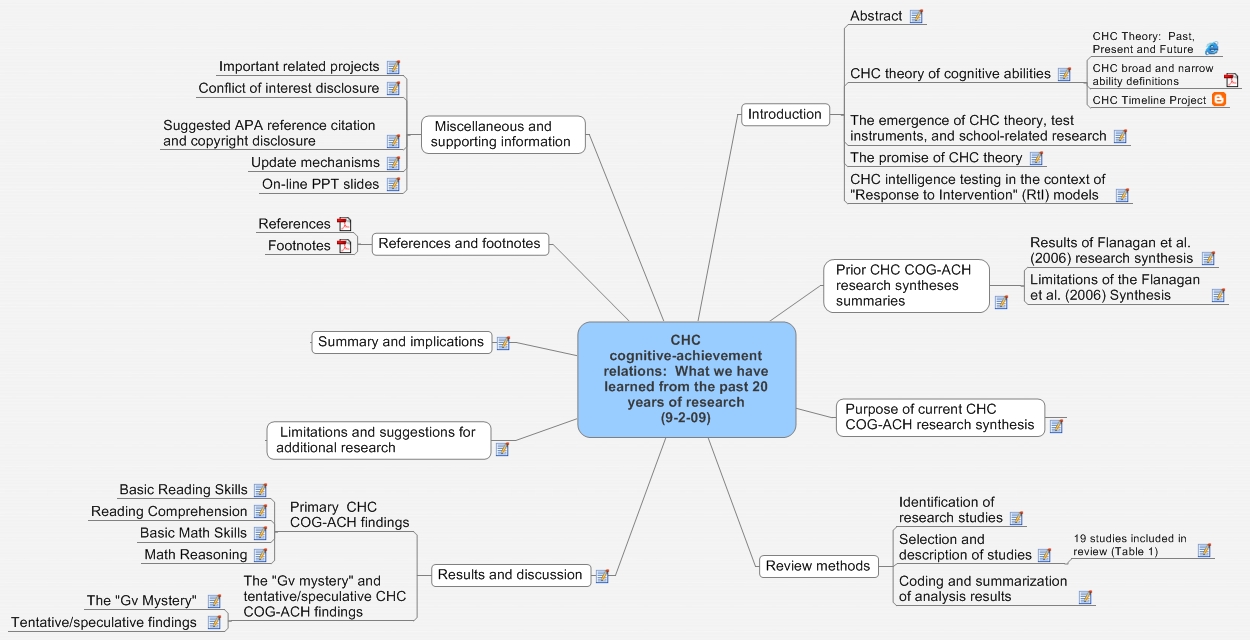
CHC cognitive-achievement relations project finished! It is done!


[Double click on image to enlarge]

I'm pleased to announce the completion of the Cattell - Horn - Carroll (CHC) Cognitive Abilities-Achievement Research Synthesis project, a project first described in a prior post. The purpose of this project is to systematically synthesize the key Cattell-Horn- Carroll (CHC) theory of cognitive abilities designed research studies that have investigated the relations between broad and narrow CHC abilities and school achievement.

The project can be accessed via a clickable MindMap visual-graphic navigational tool (similar to the image above...but "active" and "dyanamic") or via the more traditional web page outline navigational method. You can toggle back and forth between the different navigation methods via the options in the upper right hand corner of the respective home web page.

Feedback is appreciated. I request that feedback be funneled to either the CHC and/or NASP professional listservs, mechanisms that provide for a more dynamic give-and-take exchange of ideas, thoughts, reactions, criticisms, suggestions, etc.

This project, in a briefer journal form, is currently "in press" in a special CHC issue of Psychology in the Schools (McGrew & Wendling, in press).

Enjoy.


Technorati Tags: , , , , , , , , , , , , , , , , , , , , , ,

Powered by ScribeFire.

Monday, August 31, 2009

Reading the bumps on your head--blast from the past

Thanks to MIND HACKS to link to historical information on phrenology

http://www.mindhacks.com/blog/2009/08/the_automated_phreno.html


Kevin McGrew PhD
Educational/School Psych.
IAP (www.iapsych.com)

Sent from KMcGrew iPhone (IQMobile). (If message includes an image-
double click on it to make larger-if hard to see)

Thursday, August 27, 2009

Wednesday, August 26, 2009

IQs Corner Recent Literature of Interest 8-26-09

This weeks "recent literature of interest" is now available. Click here to view or download.

Information regarding this feature, its basis, and the reasons for type of references included in each weekly installment can be found in a prior post.

Technorati Tags: , , , , , ,

New IQ, MR and Death Penalty blog


IQ, MR and the death penalty.

Today I'm announcing a new blog projected related to the "life-and-death" (literally) issues surrounding Atkins cases...court cases dealing with the topic of mental retardation and the death penalty.  The blog has a specific focus on the intellectual competence (IQ) issues and research surrounding Atkin's cases.

Additional information can be found at Intellectual Competence and the Death Penalty blog.  The announcement statement can be viewed here.

Technorati Tags: , , , , , , , , , , , , , , , , ,

iJournal: New JPA articles

Double click on image to enlarge

Tuesday, August 25, 2009

iAbstract: Neuropsych developments

Double click image to enlarge

iAbstract: Executive function disorder subtypes?

Double click image to enlarge

Neuropsychology - Volume 23, Issue 5


Sent from KMcGrew iPhone (IQMobile). (If message includes an image-double click on it to make larger-if hard to see) 


A new issue is available for the following APA journal:

Neuropsychology

Volume 23, Issue 5

The prevalence of cortical gray matter atrophy may be overestimated in the healthy aging brain.
Pages 541-550
Burgmans, Saartje; van Boxtel, Martin P. J.; Vuurman, Eric F. P. M.; Smeets, Floortje; Gronenschild, Ed H. B. M.; Uylings, Harry B. M.; Jolles, Jelle
Impairment of probabilistic reward-based learning in schizophrenia.
Pages 571-580
Weiler, Julia A.; Bellebaum, Christian; Brüne, Martin; Juckel, Georg; Daum, Irene
Selectivity of executive function deficits in mild cognitive impairment.
Pages 607-618
Brandt, Jason; Aretouli, Eleni; Neijstrom, Eleanor; Samek, Jaclyn; Manning, Kevin; Albert, Marilyn S.; Bandeen-Roche, Karen
Frontotemporal dementia selectively impairs transitive reasoning about familiar spatial environments.
Pages 619-626
Vartanian, Oshin; Goel, Vinod; Tierney, Michael; Huey, Edward D.; Grafman, Jordan
Delaying interference enhances memory consolidation in amnesic patients.
Pages 627-634
Dewar, Michaela; Garcia, Yuriem Fernandez; Cowan, Nelson; Sala, Sergio Della
Angry faces are special too: Evidence from the visual scanpath.
Pages 658-667
Bate, Sarah; Haslam, Catherine; Hodgson, Timothy L.
ERPs in anterior and posterior regions associated with duration and size discriminations.
Pages 668-678
Gontier, Emilie; Paul, Isabelle; Le Dantec, Christophe; Pouthas, Viviane; Jean-Marie, Grouin; Bernard, Christian; Lalonde, Robert; Rebaï, Mohamed

Sent from KMcGrew iPhone (IQMobile). (If message includes an image-double click on it to make larger-if hard to see) 


Sunday, August 23, 2009

WJ III RPI and W-scores: New ASB explanatory report available

What are RPI (Relative Proficiency Index) and W-scores...how do they differ from standard scores?  Why are they the most educationally relevant scores provided by the Woodcock-Johnson III Battery [conflict of interest - I'm a coauthor of the WJ III].

Answers to these important questions are now available in ASB # 11:  Development, Interpretation, and Application of the W Score and the Relative Proficiency Index a new Assessment Service Bulletin available from Riverside Publishing.  The author of the ASB is Dr. Lynne Jaffe.  Click here to access the Riverside web page that lists ASB # 11 (and all prior ASB's).

As described at the Riverside web page:
  • The purpose of this bulletin is to familiarize users of the WJ III with the development, interpretation, and application of the W score and the RPI. Specifically, this bulletin describes the levels of interpretive information available in the WJ III, explains the special characteristics and usefulness of the W scale, and describes how the RPI fits into the hierarchy of information used to interpret test results, including, the differences between the RPI and peer-comparison scores, the usefulness of the RPI in clarifying diagnostic profiles and designing interventions and considerations for using the RPI in view of the Individuals with Disabilities Education Act (IDEA) 2004, and the use of the RPI in clinical research.

Technorati Tags: , , , , , , , , , , , , , ,

Saturday, August 22, 2009

SHARP BRAINS brain fitness roundup

AlvaroF: News: DriveSharp, Cognitive Health, Posit Science and
CogniFit: Round-up of recent news on cognitive health and ..

http://bit.ly/qMEbG


Sent from KMcGrew iPhone (IQMobile). (If message includes an image-
double click on it to make larger-if hard to see)

New brain fitness game research

PsychNews: Brain-Training Games Get Mixed Scores

http://tinyurl.com/mwleag


Kevin McGrew PhD
Educational/School Psych.
IAP (www.iapsych.com)

Sent from KMcGrew iPhone (IQMobile). (If message includes an image-
double click on it to make larger-if hard to see)

Thursday, August 20, 2009

IQs Corner Recent Literature of Interest 8-20-09

This weeks "recent literature of interest" is now available. Click here to view or download.

Information regarding this feature, its basis, and the reasons for type of references included in each weekly installment can be found in a prior post.

Technorati Tags: , , , , , ,

Dependability of general (g)-factor loadings: Floyd et al. 2009

This is an update to a prior "IQ Pipeline" post regarding a manuscript that had been accepted for publication in the journal Intelligence.  The article is now official.  The reference citation (with link to copy) is:
  • Floyd, R. G., Shands, E. I., Rafael, F. A., Bergeron, R., & McGrew, K. S. (2009). The dependability of general-factor loadings: The effects of factor-extraction methods, test battery composition, test battery size, and their interactions. Intelligence, 37, 453-465. (click here to view/download)
As an FYI, the prior post included a link the to original Thorndike (1987) classic "Stability of Factor Loadings" article that was foundation of the current article.

Technorati Tags: , , , , , , , , , , , ,

Wednesday, August 19, 2009

CHC Intelligence Theory Timeline Project Update: Carroll (1985) paper found + clickable map to come

In a prior post I described the CHC Intelligence Theory Timeline Project.  I will continue to work on this project as time permits.

At this time I've got a two announcements.  First, I've been in contact with the maker of the software I'm using (Timeline Maker) about the Mozilla browser bug (see prior post) and the need I have for the program to export web-based material with all the active file, image, and URL links I have on my desktop program.  As a result, I've been placed on their list of "beta" testers for their next version which should include this feature (apparently many others have asked for the same feature).  So..hang tight.  We may have an on-line CHC Timeline on the web with clickable resources sometime soon.

The second announcement is made possible by Dr. Jack Carroll's daughter (Mimi Chapin) and her husband.  I recently sent out a listserv request in hopes of finding a copy of Carroll's unpublished 1985 paper--Domains of Cognitive Ability, which was presented at an Assocition for the Advancment of Science.  Mimi and her husband dug through Jack's files and found and sent me a copy.  I'm now making it available for others to view/download (click here).  It is an interesting read.  As early as 1985 the basic building blocks (broad stratum II abilities) of Carroll's eventual tri-stratum model can be seen.  Near the end of the paper is Table 1, which lists the broad domains (as well as the higher order g-factor) of Gf, Gc, Gv, Ga, Gs, Gi (now these abilities are typically listed under Glr in the CHC taxonomy), and Gm (which later Carroll labeled Gy...and which is now divided between Gsm and Glr in the CHC model.

Technorati Tags: , , , , , , , , , , , , , ,

Can cognitive tests differentiate Alzhemers from vascular dementia?

Can cognitive ability tests differentially diagnosis Alzheimer's from Vascular-Dementia?  A recent meta-analysis  (see reference below) suggests that the answer is "no"---cognitive measures need to be augmented by other diagnostic techniques when trying to differentiate Alzheimer's from Vascular Dementia.
  • Mathias, J. L. & Burke, J.  (2009).  Cognitive Functioning in Alzheimer’s and Vascular Dementia:A Meta-Analysis.  Neuropsychology, 23(4), 411–423

Abstract (underlining is emphasis added by blogmaster)
Differentiating between Alzheimer’s disease (AD) and vascular dementia (VaD) remains difficult but important if existing pharmacological treatments are to provide symptomatic relief in the case of AD or to alter disease progression in the case of VaD. Cognitive assessments play an important role in aiding diagnosis, despite a lack of clear evidence defining the cognitive abilities and tests that best distinguish between the two types of dementia. The current study therefore completed a meta-analysis of research comparing the cognitive abilities of persons diagnosed with AD and VaD. A comprehensive search was undertaken of the PubMed and PsychInfo databases, with 81 studies being eligible for inclusion. Weighted Cohen’s d effect sizes, percentage overlap statistics, fail-safe Ns, and confidence intervals were calculated for all cognitive tests. Of the tests that were examined by more than one study, there was one test of perception and one test of verbal memory that showed large and significant group differences. There were an additional 12 tests that may prove useful. However, all cognitive tests were limited in their ability to discriminate between AD and VaD, suggesting that they should be used cautiously and only in conjunction with other information (imaging, medical history) when diagnosing patients.
The authors conclusion
In summary, the findings of this meta-analysis suggest that the neuropsychological tests that best discriminate between AD and VaD are the Emotional Recognition task (Shimokawa et al., 2000; Shimokawa et al., 2003), and Delayed Story recall, as assessed by WMS Logical Memory (Wechsler, 1987) Adult Memory and Information Processing Battery (Coughlan & Hollows, 1985), and Babcock Story Recall (Spinnler & Tognoni, 1987). However, it is important to note that none of the tests showed acceptably low overlap between the scores of the two groups to confidently discriminate between the two types of dementia. These cognitive tests must therefore be used cautiously and in conjunction with other diagnostic information, such as medical history, behavioral observations, imaging, and information from relatives, when making a diagnosis.


Technorati Tags: , , , , , , , , , , ,

Is associative learning/memory (Glr-MA) a causal mechanism of g (general intelligence)?

What are basic elementary cognitive mechanisms/processes that contribute to (cause?) g (general intelligence).

As has been discussed many times previously on this blog, there has been a significant amount of recent research suggesting that working memory (Gsm-MW) and processing speed (Gs) may be causal mechanisms of g (click here for a brief summary and some CHC-based causal models I've run). In the article below, Kaufman et al (hereafter referred to as the "authors") investigate whether associative learning may be another causative mechanism...above and beyond the contribution of working memory and processing speed.
  • Kaufman, S. B, DeYoung, C. G, Gray, J. R., Brown, J. & Mackintosh, N. (2009). Associative learning predicts intelligence above and beyond working memory and processing speed. Intelligence, 37, 374–382 (click here to view)

Abstract
Recent evidence suggests the existence of multiple cognitive mechanisms that support the general cognitive ability factor (g). Working memory and processing speed are the two best established candidate mechanisms. Relatively little attention has been given to the possibility that associative learning is an additional mechanism contributing to g. The present study tested the hypothesis that associative learning ability, as assessed by psychometrically sound associative learning tasks, would predict variance in g above and beyond the variance predicted by working memory capacity and processing speed. This hypothesis was confirmed in a sample of 169 adolescents, using structural equation modeling. Associative learning, working memory, and processing speed all contributed significant unique variance to g, indicating not only that multiple elementary cognitive processes underlie intelligence, but also the novel finding that associative learning is one such process.

ARTICLE HIGHLIGHTS

(italics indicates direct quotes; underline indicates emphasis added by blogmaster)


the existence of general intelligence (g), in the sense of a statistical feature (a “positive manifold”), is a robustfinding, it is less clear what the mechanisms are that support g. The best established candidate processes, as mechanistic substrates of g, are processing speed (Deary, 2001) and working memory (Conway, Jarrold, Kane, Miyake, & Towse, 2007)

The current study investigated associative learning as a potential additional candidate process, which might contribute to g over and above processing speed and working memory. Only recently has associative learning become a serious contender as a substrate of g (Alexander & Smales, 1997; Tamez, Myerson, & Hale, 2008; Williams, Myerson, & Hale, 2008; Williams & Pearlberg, 2006). There is good reason, however, to suspect that the ability to learn associations might support g. Intelligent behavior seems certain to require memory for patterns of associations among stimuli, and one of the original purposes of intelligence tests was to assess students' ability to learn (Binet & Simon, 1916). Relations among associative learning, general cognitive ability, and cognitive mechanisms that subserve general cognitive ability are thus of interest for both theoretical and historical reasons.

The authors define associative learning as "the ability to remember and voluntarily recall specific associations between stimuli" In this regard, it is similar to associative memory (MA) under Glr as per the CHC taxonomy.

Although early studies found a weak or no relation between associative learning and general cognitive ability (Malmi, Underwood, & Carroll, 1979; Underwood, Boruch, & Malmi, 1978; Woodrow, 1938, 1946), the failure to find a relation seems likely to be due to the fact that the associative learning tests that were used in these studies were easy and thus unlikely to be related to complex cognition

The sample was "169 participants (54 males and 115 females) included in the analysis were aged 16–18 years, and attended a selective Sixth Form College (which takes high-achieving students who are in their last 2 years of secondary education) in Cambridge, England."

The authors operationally defined an associative learning (AL) latent factor (Glr-MA as per CHC as interpreted by the blogmaster) via multiple associative learning indicators (see article). Gf was operationally measured by the Raven's advanced progressive matrices (RAPM), DAT verbal reasoning test and the Mental rotations test. Mulitple indicators of Gs included the Verbal speed test (Speed-V) from the Berlin model of Intelligence Structure, the Numerical speed test (Speed-N), and the Speed of Information Processing sub-test from the British Ability Scales. The working memory measurement model consisted of the Operation span task. The authors used structural equation method to test predictions about the independent prediction of g by associative learning (Glr-MA), working memory (Gsm-MW), and processing speed (Gs). The final causal model can be seen in the included visual-graphic causal model diagram. Note that, as per the CHC taxonomy, I would relabel the latent factors as Glr-MA (not AL), Gsm-MW (not WM), and Gs (the same as the authors).

[double click on image to enlarge]


The primary results, as represented in the above causal model diagram:

showed that associative learning, working memory, and processing speed all made statistically independent contributions to g. This finding suggests that each of these elementary cognitive processes may represent a mechanism that contributes differentially to general intelligence

Conclusions of authors
The results of the current study add to a growing literature on the existence of multiple cognitive mechanisms that support general cognitive ability (Sternberg & Pretz, 2005). Our findings suggest that multiple cognitive processes — including the abilities to process information quickly, to maintain, update, and manipulate information in working memory, and to learn specific associations between stimuli — should contribute to performance on any highly g-loaded task. Identification of separable elementary cognitive mechanisms that support g should further attempt to develop neurobiological theories of intelligence. Such theories may help to resolve current debates regarding the nature of the mechanisms underlying g (e.g., Colom, Franciso, Quiroga, Shih, & FloresMendoza, 2008). Evidence exists already that working memory and associative learning rely on different regions of the PFC (Petrides, 1995, 2000; Petrides et al., 1993), and processing speed seems likely to be determined by a distinct set of biological parameters that are not yet known. The investigation of the precise number and nature of the mechanisms that underlie g remains a promising line of research.


Technorati Tags: , , , , , , , , , , , ,

Tuesday, August 18, 2009

Journal of Experimental Psychology: Learning, Memory, and Cognition - Volume 35, Issue 5


A new issue is available for the following APA journal:

Journal of Experimental Psychology: Learning, Memory, and Cognition

Volume 35, Issue 5

Deficits in cross-race face learning: Insights from eye movements and pupillometry.
Pages 1105-1122
Goldinger, Stephen D.; He, Yi; Papesh, Megan H.
Use of self-to-object and object-to-object spatial relations in locomotion.
Pages 1137-1147
Xiao, Chengli; Mou, Weimin; McNamara, Timothy P.
Test sequence priming in recognition memory.
Pages 1162-1174
Johns, Elizabeth E.; Mewhort, D. J. K.
Neural correlates of individual differences in strategic retrieval processing.
Pages 1175-1186
Bridger, Emma K.; Herron, Jane E.; Elward, Rachael L.; Wilding, Edward L.
Component structure of individual differences in true and false recognition of faces.
Pages 1207-1230
Bartlett, James C.; Shastri, Kalyan K.; Abdi, Hervé; Neville-Smith, Marsha
Dissociating interference-control processes between memory and response.
Pages 1306-1316
Bissett, Patrick G.; Nee, Derek Evan; Jonides, John
Attentional requirements for the selection of words from different grammatical categories.
Pages 1344-1351
Ayora, Pauline; Janssen, Niels; Dell'Acqua, Roberto; Alario, F.-Xavier
Metacognitive control over the distribution of practice: When is spacing preferred?
Pages 1352-1358
Toppino, Thomas C.; Cohen, Michael S.; Davis, Meghan L.; Moors, Amy C.
Embodied memory judgments: A case of motor fluency.
Pages 1359-1365
Yang, Shu-Ju; Gallo, David A.; Beilock, Sian L.
Classifying partial exemplars: Seeing less and learning more.
Pages 1374-1380
Taylor, Eric G.; Ross, Brian H.
Automaticity of cognitive control: Goal priming in response-inhibition paradigms.
Pages 1381-1388
Verbruggen, Frederick; Logan, Gordon D.

Monday, August 17, 2009

Brain wrinkles protect against brain injury

This story is all over the brain blogosphere

http://bit.ly/FJ6pC

Kevin McGrew PhD
Educational/School Psych.
IAP (www.iapsych.com)

Sent from KMcGrew iPhone (IQMobile). (If message includes an image-
double click on it to make larger-if hard to see)

Spatial thinking in education

From ENL blog

http://eideneurolearningblog.blogspot.com/2009/08/musings-on-spatial-thinking-dyslexia.html


Kevin McGrew PhD
Educational/School Psych.
IAP (www.iapsych.com)

Sent from KMcGrew iPhone (IQMobile). (If message includes an image-
double click on it to make larger-if hard to see)