Tuesday, April 08, 2014

The Science of How Memory Works


----
The Science of How Memory Works
// Brain Pickings

What the four "slave" systems of the mind have to do with riding a bicycle.
"Whatever becomes of [old memories], in the long intervals of consciousness?" Henry James wistfully pondered upon turning fifty. "They are like the lines of a letter written in sympathetic ink; hold the letter to the fire for a while and the grateful warmth brings out the invisible words." James was not alone in seeking to understand the seemingly mysterious workings of human memory — something all the more urgently fascinating in our age of information overload, where we're evolving a new kind of "transactive memory." But like other scientific mysteries of how the brain works — including what actually happens while we sleep and why some people are left-handed — memory continues to give scientists more questions than answers.

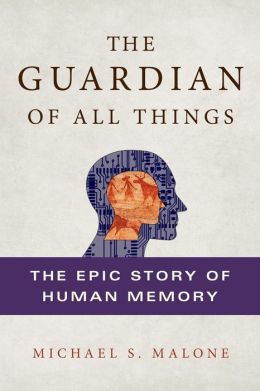
In The Guardian of All Things: The Epic Story of Human Memory (public library) technology writer Michael S. Malone takes a 10,000-year journey into humanity's understanding of our great cognitive record-keeper, exploring both its power and its ongoing perplexity.
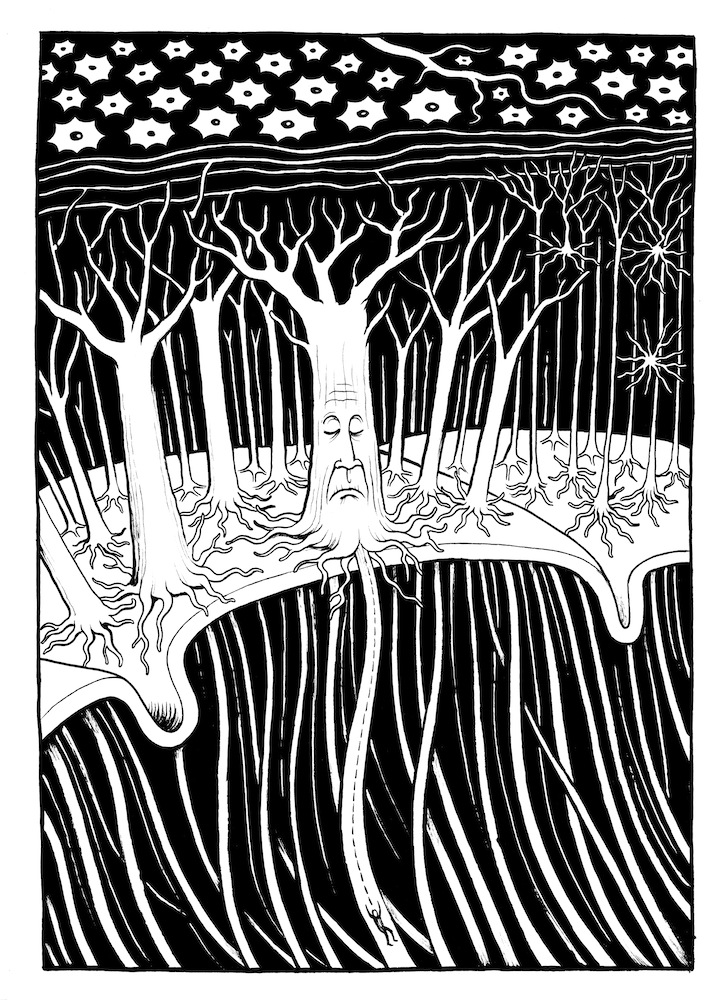
Illustration from 'Neurocomic,' a graphic novel about how the brain works. Click image for more.

One of the most astounding facts Malone points out is that memory — that is, the creation of memories — is the result of a biochemical reaction that takes place inside neurons, one particularly common among neurons responsible for our senses. Scientists have recently discovered that our short-term memory — also known as "working memory," the kind responsible for the "chunking" mechanism that powers our pattern-recognition and creativity — is localized to a few specific areas of the brain. The left hemisphere, for instance, is mostly in charge of verbal and object-oriented tasks. Even so, however, scientists remain mystified by the specific distribution, retrieval, and management of memory. Malone writes:

One popular theory holds that short-term memory consists of four "slave" systems. The first is phonological, for sound and language that (when its contents begin to fade) buys extra time through a second slave system. This second operation is a continuous rehearsal system — as you repeat a phone number you've just heard as you run to the other room for your phone. The third system is a visuo-spatial sketch pad that, as the name suggests, stores visual information and mental maps. Finally, the fourth (and most recently discovered) slave is an episodic buffer that gathers all of the diverse information in from the other slaves, and maybe other information from elsewhere, and integrates them together into what might be described as a multimedia memory.

It's worth noting that memory and creativity have a great deal in common — the combinatorial process of memory-making that Malone describes is remarkably similar to how creativity works: we gather ideas and information just by being alive and awake to the world, record some of those impressions in our mental sketch pad, then integrate the various bits into new combinations that we call our "own" ideas, a kind of "multimedia" assemblage of existing bits.
Malone goes on to explore the inner workings of long-term memory — a substantially different beast, designed to keep our permanent mental record:

Chemically, we have a pretty good idea how memories are encoded and retained in brain neurons. As with short-term memory, the storage of information is made possible by the synthesis of certain proteins in the cell. What differentiates long-term memory in neurons is that frequent repetition of signals causes magnesium to be released — which opens the door for the attachment of calcium, which in turn makes the record stable and permanent. But as we all know from experience, memory can still fade over time. For that, the brain has a chemical process called long-term potentiation that regularly enhances the strength of the connections (synapses) between the neurons and creates an enzyme protein that also strengthens the signal — in other words, the memory — inside the neuron.

From the functional, Malone moves on to the structural organization of memory, where another dichotomy emerges:

Architecturally, the organization of memory in the brain is a lot more slippery to get one's hands around (so to speak); different perspectives all seem to deliver useful insights. For example, one popular way to look at brain memory is to see it as taking two forms: explicit and implicit. Explicit, or "declarative," memory is all the information in our brains that we can consciously bring to the surface. Curiously, despite its huge importance in making us human, we don't really know where this memory is located. Scientists have, however, divided explicit memory into two forms: episodic, or memories that occurred at a specific point in time; and semantic, or understandings (via science, technology, experience, and so on) of how the world works.

Implicit, or "procedural" memory, on the other hand, stores skills and memories of how to physically function in the natural world. Holding a fork, driving a car, getting dressed — and, most famously, riding a bicycle — are all nuanced activities that modern humans do without really giving them much thought; and they are skills, in all their complexity, that we can call up and perform decades after last using them.

One of the most confounding pieces of the cognitive puzzle, however, is a form of memory known as emotional memory — a specialized system for cataloging our memories based on the emotions they evoke. It's unclear whether it belongs to the explicit or implicit domain, or to both, and scientists are still seeking to understand whether it serves as a special "search function" for the brain. (What we do now know, however, is that sharpening "emotional recall" might be the secret to better memory.)

From all this perplexity emerges Malone's bigger point, a somewhat assuring testament to the idea that science, at its best, is always driven by "thoroughly conscious ignorance":

What we do know is that — a quarter-million years after mankind inherited this remarkable organ called the brain — even with all of the tools available to modern science, human memory remains a stunning enigma.

The Guardian of All Things is a fascinating read in its entirety. Complement it with Joshua Foer's quest to hack memory to superhuman levels and Henry James on aging and memory.

Donating = Loving

Bringing you (ad-free) Brain Pickings takes hundreds of hours each month. If you find any joy and stimulation here, please consider becoming a Supporting Member with a recurring monthly donation of your choosing, between a cup of tea and a good dinner.


----

Shared via my feedly reader


Sunday, April 06, 2014

Sharing Examining Measure Correlations With Incomplete Data Sets via BrowZine

Examining Measure Correlations With Incomplete Data Sets
Raykov, Tenko; Schneider, Brooke C.; Marcoulides, George A.; Lichtenberg, Peter A.
Structural Equation Modeling: A Multidisciplinary Journal, Vol. 21 Issue 2 – 2014: 318 - 324

10.1080/10705511.2014.882696

Sharing Assessing Individual Change Using Short Tests and Questionnaires via BrowZine

Assessing Individual Change Using Short Tests and Questionnaires
Kruyen, P. M.; Emons, W. H. M.; Sijtsma, K.
Applied Psychological Measurement, Vol. 38 Issue 3 – 2014: 201 - 216

10.1177/0146621613510061

Thursday, April 03, 2014

Sharing A Flynn effect among deaf boys in Saudi Arabia via BrowZine

A Flynn effect among deaf boys in Saudi Arabia
Bakhiet, Salah eldin Farah Attallah; Barakat, Serry Mohammed Roshdy; Lynn, Richard
Intelligence, Vol. 44 – 2014: 75 - 77

10.1016/j.intell.2014.03.003

Article: Scientific American eBooks - Scientific American


Scientific American eBooks - Scientific American
http://books.scientificamerican.com/sa-ebooks/

Sent via Flipboard


*

Tuesday, April 01, 2014

Sharing Haptic Shape Processing in Visual Cortex via BrowZine

Haptic Shape Processing in Visual Cortex
Snow, Jacqueline C.; Strother, Lars; Humphreys, Glyn W.
Journal of Cognitive Neuroscience, Vol. 26 Issue 5 – 2014: 1154 - 1167

10.1162/jocn_a_00548

Sharing Prefrontal Structural Correlates of Cognitive Control during Adolescent Development: A 4-Year Longitudinal Study via BrowZine

Prefrontal Structural Correlates of Cognitive Control during Adolescent Development: A 4-Year Longitudinal Study
Vijayakumar, Nandita; Whittle, Sarah; Yücel, Murat; Dennison, Meg; Simmons, Julian; Allen, Nicholas B.
Journal of Cognitive Neuroscience, Vol. 26 Issue 5 – 2014: 1118 - 1130

10.1162/jocn_a_00549

\"Revisiting intellectual disability and the death penalty\" in APA Monitor - April 2014


I found "Revisiting intellectual disability and the death penalty" in Monitor - April 2014
Cover
April 2014

Monitor - April 2014

I thought you would enjoy "Revisiting intellectual disability and the death penalty" from Monitor - April 2014

Click the thumbnail or here to go to the issue.

If you cannot click on the links, paste this link into a browser:
http://www.apamonitor-digital.org/apamonitor/201404/?pg=0&pm=0&u1=friend&article_id=409379

Monday, March 31, 2014

Article: Fixed vs. Growth: The Two Basic Mindsets That Shape Our Lives

Check out the "Beyond IQ" project at IQs Corner for similar and more info on this and other non-cognitive constructs

Fixed vs. Growth: The Two Basic Mindsets That Shape Our Lives
http://www.brainpickings.org/index.php/2014/01/29/carol-dweck-mindset/

Sent via Flipboard


******************************************************
Kevin McGrew, PhD
Educational Psychologist
Director, Institute for Applied Psychometrics
IAP
******************************************************

Article: The Myth Of The Bell Curve: Look For The Hyper-Performers


*

Saturday, March 29, 2014

Sharing Electrophysiological correlates of attention networks in childhood and early adulthood via BrowZine

Electrophysiological correlates of attention networks in childhood and early adulthood
Abundis-Gutiérrez, Alicia; Checa, Purificación; Castellanos, Concepción; Rosario Rueda, M.
Neuropsychologia, Vol. 57 – 2014: 78 - 92

10.1016/j.neuropsychologia.2014.02.013

Sharing Do executive functions predict the ability to learn problem-solving principles? via BrowZine

Do executive functions predict the ability to learn problem-solving principles?
Ropovik, Ivan
Intelligence, Vol. 44 – 2014: 64 - 74

10.1016/j.intell.2014.03.002

Sharing The Reliability of Clinical Diagnoses: State of the Art via BrowZine

The Reliability of Clinical Diagnoses: State of the Art
Kraemer, Helena Chmura
Annual Review of Clinical Psychology, Vol. 10 Issue 1 – 2014: 111 - 130

10.1146/annurev-clinpsy-032813-153739

Sharing Exploratory Structural Equation Modeling: An Integration of the Best Features of Exploratory and Confirmatory Factor Analysis via BrowZine

Exploratory Structural Equation Modeling: An Integration of the Best Features of Exploratory and Confirmatory Factor Analysis
Marsh, Herbert W.; Morin, Alexandre J.S.; Parker, Philip D.; Kaur, Gurvinder
Annual Review of Clinical Psychology, Vol. 10 Issue 1 – 2014: 85 - 110

10.1146/annurev-clinpsy-032813-153700

Sharing The Cycle of Classification:DSM-IThroughDSM-5 via BrowZine

The Cycle of Classification:DSM-IThroughDSM-5
Blashfield, Roger K.; Keeley, Jared W.; Flanagan, Elizabeth H.; Miles, Shannon R.
Annual Review of Clinical Psychology, Vol. 10 Issue 1 – 2014: 25 - 51

10.1146/annurev-clinpsy-032813-153639

University of Minnesota Users:
https://www.lib.umn.edu/log.phtml?url=http://www.annualreviews.org/doi/abs/10.1146/annurev-clinpsy-032813-153639

Non-University of Minnesota Users: (Full text may not be available)
http://www.annualreviews.org/doi/abs/10.1146/annurev-clinpsy-032813-153639

Accessed with BrowZine,

Friday, March 28, 2014

Sharing Individual differences in working memory capacity explain the relationship between general discrimination ability and psychometric intelligence via BrowZine

Individual differences in working memory capacity explain the relationship between general discrimination ability and psychometric intelligence
Troche, Stefan J.; Wagner, Felicitas L.; Voelke, Annik E.; Roebers, Claudia M.; Rammsayer, Thomas H.
Intelligence, Vol. 44 – 2014: 40 - 50

10.1016/j.intell.2014.02.009

University of Minnesota Users:
https://www.lib.umn.edu/log.phtml?url=http://www.sciencedirect.com/science/article/pii/S0160289614000294

Non-University of Minnesota Users: (Full text may not be available)
http://www.sciencedirect.com/science/article/pii/S0160289614000294

Thursday, March 27, 2014

Sharing Early Foundations for Mathematics Learning and Their Relations to Learning Disabilities via BrowZine

Early Foundations for Mathematics Learning and Their Relations to Learning Disabilities
Geary, D. C.
Current Directions in Psychological Science, Vol. 22 Issue 1 – 2013: 23 - 27

10.1177/0963721412469398

University of Minnesota Users:
https://www.lib.umn.edu/log.phtml?url=http://cdp.sagepub.com/lookup/doi/10.1177/0963721412469398

Non-University of Minnesota Users: (Full text may not be available)
http://cdp.sagepub.com/lookup/doi/10.1177/0963721412469398

Accessed with BrowZine,

Sharing Exploring and Enhancing Spatial Thinking: Links to Achievement in Science, Technology, Engineering, and Mathematics? via BrowZine

Exploring and Enhancing Spatial Thinking: Links to Achievement in Science, Technology, Engineering, and Mathematics?
Uttal, D. H.; Miller, D. I.; Newcombe, N. S.
Current Directions in Psychological Science, Vol. 22 Issue 5 – 2013: 367 - 373

10.1177/0963721413484756

University of Minnesota Users:
https://www.lib.umn.edu/log.phtml?url=http://cdp.sagepub.com/lookup/doi/10.1177/0963721413484756

Non-University of Minnesota Users: (Full text may not be available)
http://cdp.sagepub.com/lookup/doi/10.1177/0963721413484756

Accessed with BrowZine, supported by University of Minnesota.


******************************************************
Kevin McGrew, PhD
Educational Psychologist
Director, Institute for Applied Psychometrics
IAP
www.themindhub.com
******************************************************

Sharing The Benefits of Cognitive Disfluency via BrowZine

The Benefits of Cognitive Disfluency
Alter, A. L.
Current Directions in Psychological Science, Vol. 22 Issue 6 – 2013: 437 - 442

10.1177/0963721413498894

University of Minnesota Users:
https://www.lib.umn.edu/log.phtml?url=http://cdp.sagepub.com/lookup/doi/10.1177/0963721413498894

Non-University of Minnesota Users: (Full text may not be available)
http://cdp.sagepub.com/lookup/doi/10.1177/0963721413498894

Accessed with BrowZine, supported by University of Minnesota.


******************************************************
Kevin McGrew, PhD
Educational Psychologist
Director, Institute for Applied Psychometrics
IAP
www.themindhub.com
******************************************************

The brains brake? Inhibition and the right inferior frontal cortex: one decade on via BrowZine

The brains brake?

Inhibition and the right inferior frontal cortex: one decade on
Aron, Adam R.; Robbins, Trevor W.; Poldrack, Russell A.
Trends in Cognitive Sciences, Vol. 18 Issue 4 – 2014: 177 - 185

10.1016/j.tics.2013.12.003

University of Minnesota Users:
https://www.lib.umn.edu/log.phtml?url=http://www.sciencedirect.com/science/article/pii/S136466131300274X

Non-University of Minnesota Users: (Full text may not be available)
http://www.sciencedirect.com/science/article/pii/S136466131300274X

Accessed with BrowZine,

Tuesday, March 25, 2014

No comments


I am turning off the "comments" feature of this blog. Within the last year internet bots have been making 99% of useless comments, which I need to moderate. It is taking too much time. Sorry.....


Article: Study: Humans Display Highest Cognitive Abilities When Trying To Retrieve Object Dropped Between Car Seats


Study: Humans Display Highest Cognitive Abilities When Trying To Retrieve Object Dropped Between Car Seats
http://www.theonion.com/articles/study-humans-display-highest-cognitive-abilities-w,35602/

Sent via Flipboard


Saturday, March 22, 2014

Article: The subway of the brain – Why white matter matters.

White matter matters
The subway of the brain – Why white matter matters.
http://blogs.biomedcentral.com/bmcblog/2014/03/14/the-subway-of-the-brain-why-white-matter-matters/

Sent via Flipboard


Sharing Assessing the function of the fronto-parietal attention network: Insights from resting-state fMRI and the attentional network test via BrowZine

Assessing the function of the fronto-parietal attention network: Insights from resting-state fMRI and the attentional network test
Markett, Sebastian; Reuter, Martin; Montag, Christian; Voigt, Gesine; Lachmann, Bernd; Rudorf, Sarah; Elger, Christian E.; Weber, Bernd
Human Brain Mapping, Vol. 35 Issue 4 – 2014: 1700 - 1709

10.1002/hbm.22285

University of Minnesota Users:
https://www.lib.umn.edu/log.phtml?url=http://doi.wiley.com/10.1002/hbm.22285

Non-University of Minnesota Users: (Full text may not be available)
http://doi.wiley.com/10.1002/hbm.22285

Accessed with BrowZine, supported by University of Minnesota.


******************************************************

Sharing Dysmaturation of the default mode network in autism via BrowZine

Dysmaturation of the default mode network in autism
Washington, Stuart D.; Gordon, Evan M.; Brar, Jasmit; Warburton, Samantha; Sawyer, Alice T.; Wolfe, Amanda; Mease-Ference, Erin R.; Girton, Laura; Hailu, Ayichew; Mbwana, Juma; Gaillard, William D.; Kalbfleisch, M. Layne; VanMeter, John W.
Human Brain Mapping, Vol. 35 Issue 4 – 2014: 1284 - 1296

10.1002/hbm.22252

University of Minnesota Users:
https://www.lib.umn.edu/log.phtml?url=http://doi.wiley.com/10.1002/hbm.22252

Non-University of Minnesota Users: (Full text may not be available)
http://doi.wiley.com/10.1002/hbm.22252

Accessed with BrowZine, supported by University of Minnesota.
supported by University of Minnesota.


******************************************************
Kevin McGrew, PhD
Educational Psychologist
Director, Institute for Applied Psychometrics
IAP
www.themindhub.com
******************************************************

******************************************************
Kevin McGrew, PhD
Educational Psychologist
Director, Institute for Applied Psychometrics
IAP
www.themindhub.com
******************************************************

Sharing Long-term memory and the control of attentional control via BrowZine

Long-term memory and the control of attentional control
Mayr, Ulrich; Kuhns, David; Hubbard, Jason
Cognitive Psychology, Vol. 72 – 2014: 1 - 26

10.1016/j.cogpsych.2014.02.001

University of Minnesota Users:
https://www.lib.umn.edu/log.phtml?url=http://www.sciencedirect.com/science/article/pii/S0010028514000164

Non-University of Minnesota Users: (Full text may not be available)
http://www.sciencedirect.com/science/article/pii/S0010028514000164

Accessed with BrowZine,

Tuesday, March 18, 2014

Epilepsy & IQ: The clinical utility of the Wechsler Adult Intelligence Scale-Fourth Edition (WAIS-IV) indices in the neuropsychological assessment of people with epilepsy [feedly]


Epilepsy & IQ: The clinical utility of the Wechsler Adult Intelligence Scale-Fourth Edition (WAIS-IV) indices in the neuropsychological assessment of people with epilepsy
// JOURNAL OF CLINICAL AND EXPERIMENTAL NEUROPSYCHOLOGY - Web of Knowledge
Title: Epilepsy & IQ: The clinical utility of the Wechsler Adult Intelligence Scale-Fourth Edition (WAIS-IV) indices in the neuropsychological assessment of people with epilepsy
Author(s): Baxendale, Sallie; McGrath, Katherine; Thompson, Pamela J.
Source: JOURNAL OF CLINICAL AND EXPERIMENTAL NEUROPSYCHOLOGY, 36 (2): 137-143 FEB 2014
IDS#: AB2CN. ISSN: 1380-3395

----
Shared via my feedly reader


Article: Cronbach: Factor analysis is more like photography than chemistry.

And another great historical take from Joel Schneider

**

Monday, March 17, 2014

Sharing Development and validation of the knowledge-building environment scale via BrowZine

Development and validation of the knowledge-building environment scale
Lin, Kuei Yu; Hong, Huang-Yao; Chai, Ching Sing
Learning and Individual Differences, Vol. 30 – 2014: 124 - 132

10.1016/j.lindif.2013.10.018

University of Minnesota Users:
https://www.lib.umn.edu/log.phtml?url=http://www.sciencedirect.com/science/article/pii/S1041608013001805

Non-University of Minnesota Users: (Full text may not be available)
http://www.sciencedirect.com/science/article/pii/S1041608013001805

Accessed with BrowZine,

Sharing Mental rotation ability in relation to self-perceptions of high school geometry via BrowZine

Mental rotation ability in relation to self-perceptions of high school geometry
Weckbacher, Lisa Marie; Okamoto, Yukari
Learning and Individual Differences, Vol. 30 – 2014: 58 - 63

10.1016/j.lindif.2013.10.007

University of Minnesota Users:
https://www.lib.umn.edu/log.phtml?url=http://www.sciencedirect.com/science/article/pii/S1041608013001532

Non-University of Minnesota Users: (Full text may not be available)
http://www.sciencedirect.com/science/article/pii/S1041608013001532

Accessed with BrowZine,

Sunday, March 16, 2014

Article: Brain Facts book - BrainFacts.org


*******************************************
Kevin McGrew, PhD
Educational Psychologist
Director, IAP
*******************************************

Thursday, March 13, 2014

Different Brain Regions Handle Different Musics [feedly]


Different Brain Regions Handle Different Musics
// Scientific American: Mind & Brain
Functional MRI of the listening brain found that different regions become active when listening to different types of music and instrumental versus vocals. Allie Wilkinson reports.    

-- Read more on ScientificAmerican.com


----
Shared via my feedly reader


Friday, March 07, 2014

The TIme Doc...one of the other hats I wear :)

Click on "read more" box under my picture


The Tempo Times | March 2014: Brain Health Edition
Logo Home | Provider Login | IM University | IM-Home | eClinic
IM University

Register for an IM Course at the low price:

$149

Date Location
3/8 Las Vegas, NV
3/15 Reading, PA
3/22 Jersey City, NJ
3/22 Seattle, WA
3/29 Carrollton, GA
3/29 Chicago, IL
4/5 Albany, NY
4/5 Columbia, SC
4/5 Dallas, TX
4/5 Inverness, FL
4/12 Boston, MA
4/12 Long Beach, CA
4/12 Long Island, NY
4/12 Wichita, KS

Pediatric CourseThis symbol indicates an Advanced Pediatric Course following the scheduled IM Certification Course.

Pediatric CourseThis symbol indicates an Advanced Adult Course following the scheduled IM Certification Course.

  REGISTER NOW   ›  

We are looking for Webinar Presenters!

Get compensated for sharing your IM knowledge with other providers! We are looking for presentations for 2014. Click here to submit a description. If your presentation is accepted, you will receive $350 upon completion of the your live webinar presentation.


Meet March's Professional of the Month:
Dr. Kevin McGrew

Dr. Kevin McGrew, the Time Doc, is a member of the IM scientific advisory board and a strong advocate for the importance of better neural timing. In addition to co-authoring the fourth edition of the Woodcock-Johnson battery (WJ IV), he is the Director of the Institute for Applied Psychometrics (IAP), the Research Director for the Woodcock-Muñoz Foundation (WMF) and a visiting professor in Educational Psychology at the University of Minnesota, where he received his doctoral degree in the same field. Dr. McGrew clearly understands how to use his time wisely. After spending 12 years as a school psychologist, and another 10 as a professor of Applied Psychology, Dr. McGrew switched his focus to research. He has published over 70 articles, books and book chapters in his areas of expertise and maintains IQ's Corner blog and the Mindhub®. Look for Dr. McGrew in our upcoming IM demo video where he explains the importance of getting your brain and body in sync.


  Read more in our blog...   ›  
 

Friendly Fire: A Look at Multiple Sclerosis (MS)

MS mriMultiple Sclerosis (MS) is a chronic, unpredictable condition that can rob individuals of their ability to live a normal, healthy life. Since lesions and plaque scars appear on multiple areas of brain matter, the severity and symptoms vary drastically. While some people my live a full, happy life with very few interruptions, others have their life cut short by a malignantly progressive form of the disease. With IM, you don't just adapt to MS, you can slow the progression and actually regain functional mobility. Today, we look at some of the symptoms of MS, treatment options, and the success of Margaret, a MS sufferer who uses IM to stay mobile and active.

 

  Read more in our blog...   ›  

IM-Home Tips and Motivational Strategiesmom and daughters

In case you missed our free webinar in January, we wanted to share some of the great tips for using Interactive Metronome® (IM) at home. IM-Home lets users train in the comfort and privacy of their own home while still receiving Provider-supervised IM training. It's time to take the clinic to your clients! IM-Home is also great for children looking for an edge in the classroom, athletes who want an advantage on the field and adults who want to excel professionally.

Read more in our blog...   ›  


Upcoming Webinars

▪    Effects of IM training on soccer skill performance in a sample of female elite soccer players

Soccer GirlThis webinar is based on a large study on elite female soccer players, investigating the effects of timing-training (IM) on soccer-specific skills. It will have emphasis on the effects of IM training on the performance of a number of soccer-specific skills (cross-pass, shot for goal and heading), but will also address some of the customized IM-exercises used, and the reasoning behind the choice of these specific exercises.

Moreover, the webinar will include some preliminary analyses of brain activation patterns (fMRI) before and after IM training. Here, we have investigated if the internal / cognitive representations of an observed action may change as an effect of IM training.

Date: 5/28/14
Time: 12:30 pm EST
Price: $15
CEUS: AOTA 0.1, BOC 1.0, PTs & PTAs may submit paperwork to your state board

  Register Now   ›  

HAVE A QUESTION? CONTACT YOUR SALES REPRESENTATIVE


This email was sent to iapsych@charter.net
why did I get this?    unsubscribe from this list    update subscription preferences
Interactive Metronome · 13798 NW 4th Street · Suite 300 · Sunrise, FL 33325 · USA

Article: How Daydreaming Can Actually Make You Smarter


Article: Brain Training And The End Of The Prozac Generation


******************************************************
Kevin McGrew, PhD
Educational Psychologist
Director, Institute for Applied Psychometrics
IAP
******************************************************

Wednesday, March 05, 2014

Article: How the Brain Sorts Out Speech Sounds


*

Sharing Neuroimaging predictors of cognitive performance across a standardized neurocognitive battery. via BrowZine

Neuroimaging predictors of cognitive performance across a standardized neurocognitive battery.
Roalf, David R.; Ruparel, Kosha; Gur, Raquel E.; Bilker, Warren; Gerraty, Raphael; Elliott, Mark A.; Gallagher, R. Sean; Almasy, Laura; Pogue-Geile, Michael F.; Prasad, Konasale; Wood, Joel; Nimgaonkar, Vishwajit L.; Gur, Ruben C.
Neuropsychology, Vol. 28 Issue 2 – 2014: 161 - 176

10.1037/neu0000011

University of Minnesota Users:
https://www.lib.umn.edu/log.phtml?url=http://doi.apa.org/getdoi.cfm?doi=10.1037/neu0000011

Non-University of Minnesota Users: (Full text may not be available)
http://doi.apa.org/getdoi.cfm?doi=10.1037/neu0000011

Accessed with BrowZine,

Article: New evidence confirms link between IQ and brain cortex

This study was previously posted, with comments, at my ICDP blog, where a link is provided to an annotated copy of the article.


******************************************************
Kevin McGrew, PhD
Educational Psychologist
Director, Institute for Applied Psychometrics
IAP
******************************************************

Monday, March 03, 2014

Fwd: [New post] I love the animation package in R!

Joel Schneider does it again...amazing Gv animated presenations


---------- Forwarded message ----------
From: Assessing Psyche, Engaging Gauss, Seeking Sophia <comment-reply@wordpress.com>
Date: March 3, 2014 at 6:33:04 PM CST
Subject: [New post] I love the animation package in R!
To: wj3chc@gmail.com

WordPress.com
W. Joel Schneider posted: "I am grateful that we live in an age in which individuals like Yihui Xie make things that help others make things. Aside from his extraordinary work with knitr, I am enjoying the ability to make any kind of animation I want with his animation package. My "
Respond to this post by replying above this line

New post on Assessing Psyche, Engaging Gauss, Seeking Sophia

I love the animation package in R!

by W. Joel Schneider

I am grateful that we live in an age in which individuals like Yihui Xie make things that help others make things. Aside from his extraordinary work with knitr, I am enjoying the ability to make any kind of animation I want with his animation package. My introductory stats lectures are less boring when I can make simple graphs move:

Correlations

Correlations

Code:
cnt<-1000
for (i in c(-0.9999,-0.999,seq(-0.995,0.995,0.005),0.999,0.9999,0.999,seq(0.995,-0.995,-.005),-0.999)){
Cairo(file=paste0("S",cnt,".png"),bg="white",width=700,height=700)
cnt<-cnt+1
rho<-i
plot(matrix(rep(1,2*n),nrow=n)%*%diag(m)+d%*%chol(matrix(c(1,rho,rho,1),nrow=2))%*%diag(s),pch=16,col=rgb(0,0.12,0.88,alpha=0.3),ylab="Y",xlab="X", xlim=c(40,160), ylim=c(40,160),axes=F,main=bquote(rho==.(format(round(rho,2),nsmall=2))))
lines(c(40,160),(c(40,160)-100)*rho+100,col="firebrick2")
axis(1)
axis(2)
dev.off()
}
ani.options(convert = shQuote('C:/Program Files/ImageMagick-6.8.8-Q16/convert.exe'),ani.width=700, ani.height=800,interval = 0.05,ani.dev="png",ani.type="png")
im.convert("S*.png",output="SEE1.gif",extra.opts="-dispose Background",clean=T)

W. Joel Schneider | March 4, 2014 at 12:32 am | Tags: animation, R, Yihui Xie | Categories: R, Statistics | URL: http://wp.me/p177GY-ln

Comment    See all comments

Unsubscribe to no longer receive posts from Assessing Psyche, Engaging Gauss, Seeking Sophia.
Change your email settings at Manage Subscriptions.

Trouble clicking? Copy and paste this URL into your browser:
http://assessingpsyche.wordpress.com/2014/03/04/i-love-the-animation-package-in-r/

Thanks for flying with WordPress.com

Hall v Florida SCOTUS transcript from today

Here is today's transcript for the oral arguements and questioning before the US Supreme Court (SCOTUS) re the Hall v Florida Atkins case. To someone who has worked his entire career in intelligence testing, it is very interesting to hear the justices talk about IQ, SEM, etc.

Amicus briefs from APA and AAIDD (and others) have been posted previously at this blog. Prior decisions regarding Hall v Florida are available in the blogroll under Atkins decisions


Sunday, March 02, 2014

Sharing Different Brains Process Numbers Differently: Structural Bases of Individual Differences in Spatial and Nonspatial Number Representations via BrowZine

Different Brains Process Numbers Differently: Structural Bases of Individual Differences in Spatial and Nonspatial Number Representations
Krause, Florian; Lindemann, Oliver; Toni, Ivan; Bekkering, Harold
Journal of Cognitive Neuroscience, Vol. 26 Issue 4 – 2014: 768 - 776

10.1162/jocn_a_00518

University of Minnesota Users:
https://www.lib.umn.edu/log.phtml?url=http://www.mitpressjournals.org/doi/abs/10.1162/jocn_a_00518

Non-University of Minnesota Users: (Full text may not be available)
http://www.mitpressjournals.org/doi/abs/10.1162/jocn_a_00518

Accessed with BrowZine,
******************************************************

Sharing Age-related and Genetic Modulation of Frontal Cortex Efficiency via BrowZine

Age-related and Genetic Modulation of Frontal Cortex Efficiency
Nyberg, Lars; Andersson, Micael; Kauppi, Karolina; Lundquist, Anders; Persson, Jonas; Pudas, Sara; Nilsson, Lars-Göran
Journal of Cognitive Neuroscience, Vol. 26 Issue 4 – 2014: 746 - 754

10.1162/jocn_a_00521

University of Minnesota Users:
https://www.lib.umn.edu/log.phtml?url=http://www.mitpressjournals.org/doi/abs/10.1162/jocn_a_00521

Non-University of Minnesota Users: (Full text may not be available)
http://www.mitpressjournals.org/doi/abs/10.1162/jocn_a_00521

Accessed with BrowZine
******************************************************

Sharing Representation, Control, or Reasoning? Distinct Functions for Theory of Mind within the Medial Prefrontal Cortex via BrowZine

Representation, Control, or Reasoning? Distinct Functions for Theory of Mind within the Medial Prefrontal Cortex
Hartwright, Charlotte E.; Apperly, Ian A.; Hansen, Peter C.
Journal of Cognitive Neuroscience, Vol. 26 Issue 4 – 2014: 683 - 698

10.1162/jocn_a_00520

University of Minnesota Users:
https://www.lib.umn.edu/log.phtml?url=http://www.mitpressjournals.org/doi/abs/10.1162/jocn_a_00520

Non-University of Minnesota Users: (Full text may not be available)
http://www.mitpressjournals.org/doi/abs/10.1162/jocn_a_00520

Accessed with

Article: Electrophysiological indices of interference resolution covary with individual fluid intelligence: investigating reactive control processes in a 3-back working memory task


Electrophysiological indices of interference resolution covary with individual fluid intelligence: investigating reactive control processes in a 3-back working memory task
http://www.sciencedirect.com/science/article/pii/S1053811914001190

Sent via Flipboard

*