Wednesday, November 01, 2006

IQs Corner Headlines from the brain and mind blogsphere 11-1-06

All the news thats fit for IQs Corner readers:

This is the 8th installment of IQs Corner Headlines from the Brain and Mind Blogsphere

, , , , , , , , , , , , , , , ,

powered by performancing firefox

Random tidbits from the brain and mind blogsphere 11-1-06

  • The BBC has an interesting news story about the future including new "brain boost" drugs that might enhance intellectual performance.
  • Science Dailey reports on a study from Chapel Hill's Frank Porter Graham Child Development Institute that highlights the important role fathers play in child language development
  • SharpBrains has a nice post, with lots of links, regarding "neurogenesis and how learning saves your neurons"


Technorati Tags: , , , , , , , , , , , , , ,

powered by performancing firefox

Tuesday, October 31, 2006

Random tidbits from the mind and brain blogpshere 10-31-06

  • Interesting article at BPS Research Digest on boosting Gv (visual skills) in lower SES populatons to boost their confidence in the world of work, and increase job performance.
  • A tech tidbit from the Download Squad. I'm always looking for ways to become a paper-less worker. Today they have highlighted a new light-weight e-book reader from Adobe. One of these days I'm going to try doing some e-book reading on a regular basis.
  • The Eide Neurolearning blog has posted a supposed fMRI showing the impact of chocholate on the brain...just in time for Halloween.


Technorati Tags: , , , , , , , , , , , , , ,

powered by performancing firefox

Friday, October 27, 2006

RTI and cognitive assessment--Guest post by John Garruto

The following is a guest post by John Garruto, school psychologist with the Oswego School District and member of the IQs Corner Virtual Community of Scholars. John reviewed the following article and has provided his comments below. [Blog dictator note - John's review is presented "as is" with only a few minor copy edits and the insertion of some URL links]

Hale, J.B., Kaufman, A., Naglieri, J.A. & Kavale, K.A. (2006). Implementation Of IDEA: Integrating Response To Intervention And Cognitive Assessment Methods. Psychology in the Schools, 43(7), 753-770. (click here to view)

This article (and the entire journal series in this special issue) has articulated much of what I have been saying and thinking for a long time. Hale and colleagues open up by discussing the RTI (response-to-intervention) and cognitive assessment “factions”. Although I had nothing to do with this article, I chuckled at the similarity to a PowerPoint I did for graduate study in July of 2005 (click here). I joked about these factions as having a paradigm that was analogous to “Star Wars”. I likened the idea of school psychologists who espoused both RTI and cognitive assessment as necessary requirements for the identification of SLD (Specific Learning Disability) as comprising “a rebel alliance”…primarily because it seemed we were advocating such a balanced approach. Clearly this Psychology in the Schools special issue suggests there is an increasing number of professionals who advocate this approach.

Before beginning with a general summary and sharing my overall impressions, it is important to acknowledge the obvious conflict of interest of most dissenters (in the special issue); both Kaufman (KABC-II) and Naglieri (CAS) are intelligence test authors. That said, it is important to note that two of the other authors are not test authors. In fact, Kavale (a.k.a., the intervention effect size guru) is frequently cited by many RTI-only proponents. Therefore, it is suggested that the scope of this article ending at a conflict of interest is very unlikely.

  • The Hale et al. article begins with the acknowledgment that there seem to be two factions in school psychology assessment circles--those who believe in response-to-intervention as the way to determine eligibility for SLD, and those who espouse the need for cognitive assessment. The Hale et al. article does not diminish the importance of RTI or the problem-solving model. In fact, it supports many of the changes noted in the regulations (e.g., the importance of looking at RTI as a part of the process for determining eligibility for learning disabilities.) It places emphasis on the use of empirically-based instruction and interventions. It also highlights the significance of formative assessment and ongoing progress monitoring. Such practices will illustrate the effect of interventions.
  • After supporting the importance of RTI, the authors contend that at Tier-III, a responsible individualized assessment (including cognitive assessment) needs to occur. Clearly, jumping to conclusions about a neurologically-based deficit based only on failure to RTI would lead to a significant number of false positives (Type I errors). The authors do an exemplary job of identifying the importance of cognitive processing deficits related to SLD in the problem-solving literature. This approach does not embrace the much maligned ability-achievement discrepancy LD identification procedure, but instead endorses examining those that processes are leading (if any) to the negative outcomes. The authors conclude with a case study that describes a child who seemed to have one problem on the surface, but via cognitive assessment was discovered to have an underlying latent problem (i.e., was not observably manifest.) The authors contended that this discovery, vis-à-vis appropriately designed cognitive assessment methods, facilitated the problem-solving model by allowing the team to implement new interventions. The beauty of this example is that the focus was not on eligibility as the end result, but instead, using individualized assessment to help piece the puzzle together.
  • I’ve spoken quite a bit about the authors and a possible conflict of interest. One thing I do want to mention is that I continue to be a school-based practitioner. This framework is one I have been endorsing (as a practitioner) for a long time (my presentation noted above has been online many months before this article went to press.) I’ve had many spirited debates with teachers, arguing that the spirit of formative assessment and research-based interventions has a very positive research history and we are remiss not to use these methods first. However, for those kids who are not responding, I can often complete a solid individualized assessment that provides logical reasons as to why they are not responding, and continue to provide interventions that are related to dynamics and skills that are not readily manifest. There is absolutely no doubt in my mind that combining both approaches will allow us to look beyond “eligibility” to determining what a child needs.
  • Another of my thoughts is that much of the criticism of cognitive assessment not leading to intervention has been the lack of research for establishing ATIs (aptitude-treatment-interactions). However, establishing individualized interventions based on the needs of the child (that might not have a huge history of published research) does not mean we throw it out. Many RTI-only proponents argue that we might was well go right to special education and simply intensify the research-based interventions that could be done with a special education paradigm. I argue that doing flash cards to aid sight-reading might have an empirical support base, but doing flash cards all day long (one-on-one) with a blind student isn’t going to do a thing. However, designing an intervention around the varied needs and interests of the child could (and has) lead to positive results.
  • Finally, my other concern with the RTI-only paradigm is it seems “stuck” on reading…and only on three out of the big five components of the National Reading Panel (Phonemic Awareness, Phonics, and Fluency). There is little research on using CBM for math reasoning or written expression (beyond spelling and perhaps writing fluency.) I believe the most recent edition of School Psychology Review, 35(3), which focused on CBM for reading, writing, and math might have provided practice-based school psychologists with the research we need. Quite the contrary, most all of the articles dealt with math calculations and fluency, as well as on spelling, mechanics, and writing fluency. Clearly CBM/RTI research on higher-level reasoning processes, vocabulary, induction, deduction, inferential reasoning, and writing organization, were lacking from this issue. Until RTI-only advocates start providing research and guidance in these areas, we would be remiss to discard relevant assessment techniques that provide insights into these important skills and abilities.
Technorati Tags: , , , , , , , , , , , , , , , ,

powered by performancing firefox

Thursday, October 26, 2006

Recent literature of interest 10-26-06

This weeks recent literature of interest can be found by clicking here.

I'm now experimenting with listing the references by journal title...I find it easier when looking up articles via the university library.

Technorati tags:

IQs Corner suggeston box is open

To date I, as the IQs Corner blog dictator, have been posting information that I think is exciting, informative, etc. There have been a number of guest bloggers (click here for example) who have provided additional material. I'd like to make this blog useful to a wide variety of professionals and scholars who have an interest intelligence theories and testing.

If anyone has ideas for material I should be paying attention to (articles, researchers, web pages, other blogs, etc.), ideas for posts, self-nominations for guest posts by yourself, etc., please drop me a note in the blog "comment" feature or, email me at iap@earthlink.net.

Also...if you haven't checked out my new sister blog (Tick Tock Talk: The IQ Brain Clock), maybe this is the "time." I've been posting most of the neuroscience and brain-based research I find interesting in this new little personal sand box.

Wednesday, October 25, 2006

More on mental time keeping and working memory link

Readers of IQs Corner may find a few posts I made today over on my sister blog (Tick Tock Talk: The IQ Brain Clock) of interest. One presents the predominant model of mental interval time keeping (the pacemaker accumulator model) while the other reports some very exciting linkages between the brain regions associated with cogntively controlled mental interval timing and working memory---namely, the dorsolateral prefrontal cortex.


Technorati Tags: , , , , , , , , , , , , , , , , , , ,

powered by performancing firefox

Check out Sharp Brains: Stroop Test, inhibitiion and brain-based coaching

SharpBrains is becomming one of my top/favorite "must read" blogs. Check out a post today about the Stroop test and inhibition/disinhibition.


Technorati Tags: , , , , , , , , , , , , , , ,

powered by performancing firefox

Keep your brain young: Eat your vegetables

I guess I need to jump on the blogsphere bandwagon. Every other brain, intelligence, and/or science-related blog site has posted FYI information about the recent study that suggests that eating vegetables helps to slow brain decline as you age. Click here for one representative news story. Just call me a lemming.

Technorati Tags: , , , , , , , , , , , , ,

powered by performancing firefox

Tuesday, October 24, 2006

IQs Corner headlines from the brain and mind blogsphere 10-24-06

All the news thats fit for IQs Corner readers:
This is the seventh installment of IQs Corner Headlines from the Brain and Mind Blogsphere

, , , , , , , , , , , , , , , ,

powered by performancing firefox

Random tidbits from the brain and mind blogsphere 10-24-06


  • Science Daily has interesting news reports (from the world of research) that suggests the viral infections of the CNS can lead to memory deficits (click here), new DTI methods discover possible differences in brains of individuals with autism (click here) and the identification of a possible "memory gene" (click here)

Technorati Tags: , , , , , , , , , , , , , ,

powered by performancing firefox

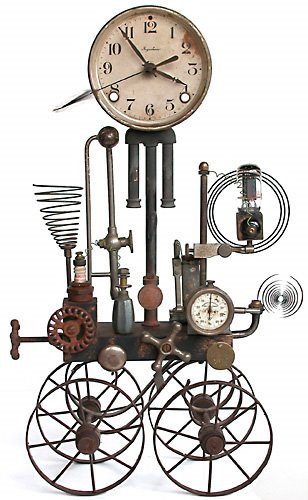
Mechanical brain sculpture


Thanks to Neurofuture for the FYI post about some very interesting looking biomechanical sculptures are by artist Lewis Tardy.

Technorati Tags: , , , , , , , , , , , , ,

powered by performancing firefox

Sunday, October 22, 2006

Off task - Free hugs

This is WAY off task for this blog.

I ran across one of the more popular videos being viewed on YouTube and it hit a personal chord (Free Hugs Campaign). Don't ask me why. I think the music (by Sick Puppies) resonated to something inside me. Also, given all the partisian political bickering (here in the US) as we approach the mid-term elections and the stuff going on in the world (Iraq, N. Korea, school violence, etc.), sometimes one person can make a difference.


Technorati Tags: , , , , , , , , , , , , , , ,

powered by performancing firefox

Recent literature of interest 10-23-06

This weeks recent literature of interest can be found by clicking here.

I'm now experimenting with listing the references by journal title...I find it easier when looking up articles via the university library.

Technorati tags:

Friday, October 20, 2006

Neuroscienjce of learning (brain-based learning): Posts moving to The IQ Brain Clock

Yesterday's posts (click here, here) dealing with facts and fictions regarding brain-based learning in education, plus the response of SharpBrains, set me off digging through my electronic library of professional articles...in search of articles on the use of neuroscience in learning in education. I found a number of good overview articles that I will comment and post shortly.

However, it dawned on me that this line of research is probably more consistent with the focus of my new blog (Tick Tock Talk: The IQ Brain Clock). Thus, this note is to inform regular IQs Corner readers that I'm going to start shifting posts focused on the neuroscience of learning over to The IQ Brain Clock Blog. I will likely also broaden the definition and purpose of that blog.

Technorati Tags: , , , , , , , , , , , , ,

powered by performancing firefox

Thursday, October 19, 2006

On Intelligence: Hawkins HTM computational theory

I LOVE blogging.

Two days ago I made the FYI post "Brain boss (prefrontal cortext) acts in step-wsie manner?" Shortly thereafter, someone posted a "comment" suggesting a link between the sequential step-wise hypothesized functioning of the prefrontal cortex and Hawkin's (2005) Hierarchical Temporal Memory (HTM) computational theory of intellectual functioning (as outlined in his book "On Intelligence"). I had never heard of this book or theory.

What I find intriguing is the fact that Hawkins is no minor player on the modern technology stage. He is well known for a number of activities--namely, he has founded founded three companies: Palm Computing (who has not heard of Palm Pilots?), Handspring, and Numenta, and the non-profit Redwood Neuroscience Institute, a scientific research institute focused on understanding how the human neocortex works.

The typical reader of IQs Corner may be wondering why someone with his background is now dabbling in understanding human intelligence. I wondered this myself. The answer lies in the Prologue to On Intelligence. A portion is reproduced below.

Maybe some readers of IQs Corner will explore this area in greater detail
  • You may be wondering why a computer designer is writing a book about brains. Or put another way, if I love brains why didn't I make a career in brain science or in artificial intelligence? The answer is I tried to, several times, but I refused to study the problem of intelligence as others have before me. I believe the best way to solve this problem is to use the detailed biology of the brain as a constraint and as a guide, yet think about intelligence as a computational problem—a position somewhere between biology and computer science. Many biologists tend to reject or ignore the idea of thinking of the brain in computational terms, and computer scientists often don't believe they have anything to learn from biology. Also, the world of science is less accepting of risk than the world of business. In technology businesses, a person who pursues a new idea with a reasoned approach can enhance his or her career regardless of whether that particular idea turns out to be successful. Many successful entrepreneurs achieved success only after earlier failures. But in academia, a couple of years spent pursuing a new idea that does not work out can permanently ruin a young career. So I pursued the two passions in my life simultaneously, believing that success in industry would help me achieve success in understanding the brain. I needed the financial resources to pursue the science I wanted, and I needed to learn how to affect change in the world, how to sell new ideas, all of which I hoped to get from working in Silicon Valley.
  • In August 2002 I started a research center, the Redwood Neuroscience Institute (RNI), dedicated to brain theory. There are many neuroscience centers in the world, but no others are dedicated to finding an overall theoretical understanding of the neocortex—the part of the human brain responsible for intelligence. That is all we study at RNI. In many ways, RNI is like a start-up company. We are pursuing a dream that some people think is unattainable, but we are lucky to have a great group of people, and our efforts are starting to bear fruit.
  • The agenda for this book is ambitious. It describes a comprehensive theory of how the brain works. It describes what intelligence is and how your brain creates it


Technorati Tags: , , , , , , , , , , , , , , , , , ,

powered by performancing firefox

More on brain-based learning article: Sharp Brains response

Sharp Brains provides a nice counter-reponse to the doom-and-gloom "Brain-based" Learning: Fiction more than Fact" article that I directed folks to earlier today. You gotta love the conversations on the blogsphere.

Technorati Tags: , , , , , , , , , , , , ,

powered by performancing firefox

Brain-based learning: Facts and fictions

There is a very interesting article in the Fall 2006 issue of the American Educator where a cognitive psychologists attempts to debunk some of the fact/fiction regarding common "brain-based" educational programs. As we all know, education often runs after fads, many of which the scientists have left a long time ago.

Aside from putting the practical realities of the recent strides in neuroscience research into proper "where the rubber meets the road" practical perspective, the author does a good job of discussing three popular myths:

1. Schools are designed for lef-brain students; 2. Schools are designed to suite girl's brains; 3. Classical music is especially important in the develoment of young brains.


This might be a good article to disseminate within educational circles.

Technorati Tags: , , , , , , , , , , , , ,

powered by performancing firefox

Brain/neuroscience websites for kids/teaching

I just learned (thanks to Mind Hacks) of a couple of very interesting websites for kids that deal with the brain and neuroscience. Check out:

Technorati Tags: , , , , , , , , , , , , , , ,

powered by performancing firefox

Free open access journals

If you are looking for free access to some journals, check out DOAJ (Directory of Open Access Journals). As lifted from the home page:
  • Welcome to the Directory of Open Access Journals. This service covers free, full text, quality controlled scientific and scholarly journals. We aim to cover all subjects and languages. There are now 2423 in the directory. Currrently 709 journals are searchable at article level. As of today 118176 journals are included in the DOAJ service.


Technorati Tags: , , , , , ,

powered by performancing firefox