- "A neurosis is a secret that you don't know you are keeping."

Intelligent Insights on Intelligence Theories and Tests
Sunday, April 09, 2006
Beyond IQ - Ability conception as an important school learning aptitude
As I've mused about on numerous occassions (click here, here, here, here, here, here), I'm a huge fan of the work of the late Richard Snow regarding the notion of "aptitude" versus "intelligence." I believe that Richard Snow was on the correct path regarding the widening of the variables individual difference psychologists need to examine to better understand a person's aptitude(s) for school learning.
My passion for Snow's concept of aptitude is based on a review of the empirical research and personal experience.....long story short.....if one believed that what is measured by intelligence tests is all one needs to know to understand a person's aptitude for school learning (and other domains -- occupations, vocational, etc.) I, based on my measured WAIS IQ as a psychology undergraduate student at Moorhead State University (now called Minnesota State University-Moorhead), should not have accomplished what I have in my field. Why have I enjoyed a reasonable degree of professional success and accomplishment above my IQ score?........largely because I've developed domain-specific expertise vis-a-vis 20+ years of sustained, passionate motivated practice in my profession, a drive due largely to variety of non-cognitive (conative) factors.
I provide the above as an introduction re: the current post, which is about one (of many) non-cognitive (conative) characteristics that contemporary social cognitive psychology has identified as important in understanding an individual's set of aptitude complexes. I stumbled across an article (burred on my hard drive) by Perkins et al (2000) that I would like to share. The reference (and link to the article) is below, followed by select tidbits regarding one of the three thinking dispostions they cover (a person's implicit view of intelligence, or, what is typically referred to as ability conception)
Perkins, D., Tishman, S., Ritchhart, R., Donis, K., & Andrade, A. (2000). Intelligence in the wild: A dispositional view of intellectual traits. Educational Psychology Review, 12(3), 269-293. (click here to view/download)
I will follow-up this post with additional information regarding ability conceptions later today, or early this week. Stay tunned.
My passion for Snow's concept of aptitude is based on a review of the empirical research and personal experience.....long story short.....if one believed that what is measured by intelligence tests is all one needs to know to understand a person's aptitude for school learning (and other domains -- occupations, vocational, etc.) I, based on my measured WAIS IQ as a psychology undergraduate student at Moorhead State University (now called Minnesota State University-Moorhead), should not have accomplished what I have in my field. Why have I enjoyed a reasonable degree of professional success and accomplishment above my IQ score?........largely because I've developed domain-specific expertise vis-a-vis 20+ years of sustained, passionate motivated practice in my profession, a drive due largely to variety of non-cognitive (conative) factors.
I provide the above as an introduction re: the current post, which is about one (of many) non-cognitive (conative) characteristics that contemporary social cognitive psychology has identified as important in understanding an individual's set of aptitude complexes. I stumbled across an article (burred on my hard drive) by Perkins et al (2000) that I would like to share. The reference (and link to the article) is below, followed by select tidbits regarding one of the three thinking dispostions they cover (a person's implicit view of intelligence, or, what is typically referred to as ability conception)
Perkins, D., Tishman, S., Ritchhart, R., Donis, K., & Andrade, A. (2000). Intelligence in the wild: A dispositional view of intellectual traits. Educational Psychology Review, 12(3), 269-293. (click here to view/download)
A few select comments/conclusions from the article (emphasis is mine):
- "Anotherlook at the dispositional side of cognitive engagement comes from the work of Bandura and Dweck (1985) and Elliott and Dweck (1985). Their research findings suggested that a person's view of how intelligence works determines how persistently the person will invest in a challenging intellectual task (Dweck, 1986). Entity learners believe that intelligence is fixed and nonchanging. They are motivated by successful displays of ability and attaining favorable judgments. They may quit when problems prove difficult, assuming they are not smart enough. In contrast, incremental learners see intelligence as learnable. They are motivated to increase their knowledge and abilities approaching challenging situations with persistence a desire to learn (Bandura and Dweck, 1985; Elliottand Dweck. 1988, as cited in Dweck, 1986)" (p. 285)


Wednesday, April 05, 2006
Stress and the brain
Thanks again to the ENL blog for the following interest article.
Technorati Tags: psychology, cognition, stress, fMRI, neuroscience, neuropsychology, brain
Why Stress is Bad for Your Brain
- More evidence that chronic stress is bad for your brain:
Technorati Tags: psychology, cognition, stress, fMRI, neuroscience, neuropsychology, brain
Tuesday, April 04, 2006
Technology to help with social skills
Not specifically related to intelligence (heck...that hasn't stopped me from posting the eclectic mix of what I find interesting to this blog), but very interesting never-the-less. I've seen this article on a number of blogs that past few weeks but never go around to posting an fyi note. This one is from the Special Education Law blog. Possible help for individuals with Asperger's, nonverbal LD, etc.?
Technology to Teach Social Skills
Technorati Tags: psychology, school psychology, cognition, education, social skills, social intelligence, technology, aspergers, nonverbal
Technology to Teach Social Skills
- "Researchers at MIT's media lab are unveiling a new device that may prove quite remarkable in teaching social skills."
Technorati Tags: psychology, school psychology, cognition, education, social skills, social intelligence, technology, aspergers, nonverbal
Neuroscience issue on working memory
Thanks to the neurodudes for the tip regarding a forthcomming issue of Neuroscience that will examine multidisciplinary approaches to the study of working memory (Gsm-MW). A press release can be be found at the link provided below
Multidisciplinary Working Memory Studies Featured (click)
Technorati Tags: psychology, cognition, educational psychology, working memory, Gsm, MW
Multidisciplinary Working Memory Studies Featured (click)
Technorati Tags: psychology, cognition, educational psychology, working memory, Gsm, MW
Monday, April 03, 2006
NASP CHC listserv meeting..Woodcock, Horn & McGrew

Thanks to Rhonda Cash for sending me a picture of myself together with Richard Woodcock and John Horn at the CHC listserv gathering at NASP 2006. John has a little Gf (fluid intelligence) operating in the picture. And...you gotta love his sweatshirt..."Random State Unversity."
Sunday, April 02, 2006
Recent literature of interest 04-02-06 posted
This weeks recent literature of interest can be found by clicking here.
Technorati tags: teaching tool. psychology.
Technorati tags: teaching tool. psychology.
I'm back...blog on
I'm back from NASP in Anaheim and may need a day or so to get back up-to-speed blogging. But I will, possibly with a renewed sense of passion and with an even greater array of topics. Many folks came up to me at NASP to say they enjoyed the blog, which provides nice positive reinforcement for the time invested. I've also been reading another book on blogging which is give me the courage to possibly take a few more risks with content, some new ideas, etc.
Blog on. But first.....my dryer has dinged and I need to fold clohtes. Many loads to do from the trip.
Blog on. But first.....my dryer has dinged and I need to fold clohtes. Many loads to do from the trip.
Wednesday, March 29, 2006
IQs Corner - book to check out - Three Pound Enigma
Thanks to the DI blog for some review comments about a book that I've had on my "read when I have time" list ----The Three Pound Enigma.
Review: The Three Pound Enigma (Click here to visit)
Technorati Tags: psychology, school psychology, cognition, neroscience, neuropsychology, fMRI, brain, Three Pound Enigma, educational psychology
Review: The Three Pound Enigma (Click here to visit)
Technorati Tags: psychology, school psychology, cognition, neroscience, neuropsychology, fMRI, brain, Three Pound Enigma, educational psychology
Tuesday, March 28, 2006
John Horn and CHC listserv NASP meeting
 Quickie post. The first ever IAP CHC listserv get-together at the National Association of School Psychologists (in Anaheim, CA) occurred this evening. Evidence is presented above....a picture of John "there ain't no g" Horn and two other great CHC-to-practice bridgers....Michael Gerner and Sam Ortiz.
More later...maybe.
Blink and Think

A tip of the hat to one of my favorite regular reads (ENL blog) for information (including link to article ) on the benefits of a reflective cognitive style to human performance.
Technorati Tags: psychology, cognition, Think, Blink, cognitive style, reflection, neuroscience, neuropsychology, conative, cognitive processing, automaticity, executive functions
Think Slow: Some Benefits of Cognitive Reflection (click here)
The gist of their post, and subsequent article resources, are consistent with the book Think (that I just finished reading.) Think is a book that is largely a response to the highly visible best selling book Blink. To simplify the value of each book, think of the following cognitive psychology analogy.- Think is to deliberate/controlled cognitive processing as Blink is to automatic cognitive processing.
Technorati Tags: psychology, cognition, Think, Blink, cognitive style, reflection, neuroscience, neuropsychology, conative, cognitive processing, automaticity, executive functions
Monday, March 27, 2006
Brain injury psychological database
A huge tip-of-the-hat to the braininjruy blog for the FYI regarding the PsycBITE databased.
Psychological Database for Brain Damage (click here)
Psychological Database for Brain Damage (click here)
PsycBITE™ is a database that catalogs studies of cognitive, behavioral and other treatments for psychological problems and issues occurring as a consequence of acquired brain impairment (ABI). The types of studies contained on this database are Systematic Reviews, Randomized Controlled Trials (RCT), Non-Randomized Controlled Trials (non-RCT), Case Series (CS), and Single Subject Design (SSD).
Sunday, March 26, 2006
WJ III Evolving Web of Knowledge (EWOK) is given birth

Announcing the first IAP EWOK (Evolving Web of Knowledge)----the WJ III EWOK. [This project is why I have not been posting as frequently to IQs Corner blog during the past 3-4 weeks.]
What is an EWOK?
An EWOK is an web-based, visually-oriented "Evolving Web of Knowledge" regarding a specific domain of knowledge of interest to the Institute for Applied Psychometrics.
The goal of an EWOK is simple: To provide a centralized up-to-date source information regarding a specific topic that is revised/updated on a semi-regular basis.
The goal of the WJ III EWOK is simple - to provide up-to-date information that has accumlulated since the WJ III battery was published in 2001. That's it... a simple goal.
The curent version (3-25-06) is FAR from being complete, but I wanted to get this "out there"so people can benefit from the currently avaialbe WJ III EWOK information.
Feedback regarding this project is welcome.
Technorati tags: mind mapping. teaching tool. CHC theory. psychology. intelligence. cognition. education. educational psychology. iq testing. psychological testing. intelligence theory. Woodock Johnson. WJ III. EWOK.
Saturday, March 25, 2006
WJ III post-publication reference list available
As promised over on the IAP CHC listserv (n=863 strong--and growing) I've completed my hard target search for all possible post-WJ III publication research. I have now posted the current reference list, which includes published journal manuscripts, select books and book chapters, and many dissertations. If readers are aware of publications that are missing, please let me know.
Click here to view/download
Also, a version that includes abstracts for almost all studies, as well as URL links to many of the journal articles (for on-line viewing and/or downloading) will be announced shortly, via the first ever WJ III EWOK (Evolving Web of Knolwedge). Stay tunned. It may be up soon.
Technorati tags: teaching tool. CHC theory. psychology. intelligence. cognition. education. educational psychology. iq testing. psychological testing. intelligence theory. Woodock Johnson. WJ III.
Click here to view/download
Also, a version that includes abstracts for almost all studies, as well as URL links to many of the journal articles (for on-line viewing and/or downloading) will be announced shortly, via the first ever WJ III EWOK (Evolving Web of Knolwedge). Stay tunned. It may be up soon.
Technorati tags: teaching tool. CHC theory. psychology. intelligence. cognition. education. educational psychology. iq testing. psychological testing. intelligence theory. Woodock Johnson. WJ III.
Thursday, March 23, 2006
The double deficit dyslexia hypothesis revisited
There is little doubt that the "double deficit" hypothesis is on of the most prominent models advanced to explain severe reading disabilities (dyslexia). It is refreshing to see a recent JLD review that casts fresh eyes on the validity of the DD hypothesis, and more importantly, a closer look at what the two core disabilities are, are not...or.....whether there is any agreement in the field re: what they represent in terms of basic underlying cognitive processes.
Below is the reference and abstract. I would encourage assessment professionals working with the education of students with reading problems to give this article a read. The authors conclude that the DD hypothesis may be given to much creedance, largely due to ubiqutous problems in research methodology across a diverse set of studies(e.g., use of different measures; different operational defintions of the core constructs; different theoretical explanations; etc.). The authors conclude that "the existing evidence does not support a persistent core deficit in naming speed for readers with dyslexia."
Although I need to reconcile this conclusion with the extant postive research that suggests that naming speed (Glr-NA: Naming Ability in the land of CHC theory)is significantly related to early reading success, such a review does give one pause. As with all highly visible established research lore, maybe the DD hypothesis, although true, may be over-stated. The article provides a nice overview of the various issues in the methodological problems in this research, competing theoretical explanations, and different attempts to define what measures of RAN (rapid automatic naming) actually measure.
Vukovic, R. K. Siegel, L. (2006). The Double-Deficit Hypothesis: A Comprehensive Analysis of the Evidence. Journal of Learning Disabilities, 39 (1), 25-47. (click here to view/download)
Abstract
Technorati Tags: psychology, educational psychology, education, special education, school psychology, learning disabilities, reading disabilities, dyslexia, naming speed, NA, Glr, phonological awareness, Ga, double deficit, reading
Below is the reference and abstract. I would encourage assessment professionals working with the education of students with reading problems to give this article a read. The authors conclude that the DD hypothesis may be given to much creedance, largely due to ubiqutous problems in research methodology across a diverse set of studies(e.g., use of different measures; different operational defintions of the core constructs; different theoretical explanations; etc.). The authors conclude that "the existing evidence does not support a persistent core deficit in naming speed for readers with dyslexia."
Although I need to reconcile this conclusion with the extant postive research that suggests that naming speed (Glr-NA: Naming Ability in the land of CHC theory)is significantly related to early reading success, such a review does give one pause. As with all highly visible established research lore, maybe the DD hypothesis, although true, may be over-stated. The article provides a nice overview of the various issues in the methodological problems in this research, competing theoretical explanations, and different attempts to define what measures of RAN (rapid automatic naming) actually measure.
Vukovic, R. K. Siegel, L. (2006). The Double-Deficit Hypothesis: A Comprehensive Analysis of the Evidence. Journal of Learning Disabilities, 39 (1), 25-47. (click here to view/download)
Abstract
- The double-deficit hypothesis of developmental dyslexia proposes that deficits in phonological processing and naming speed represent independent sources of dysfunction in dyslexia. The present article is a review of the evidence for the double-deficit hypothesis, including a discussion of recent findings related to the hypothesis. Studies in this area have been characterized by variability in methodology—how dyslexia is defined and identified, and how dyslexia subtypes are classified. Such variability sets limitations on the extent to which conclusions may be drawn with respect to the double-deficit hypothesis. Furthermore, the literature is complicated by the persistent finding that measures of phonological processing and naming speed are significantly correlated, resulting in a statistical artifact that makes it difficult to disentangle the influence of naming speed from that of phonological processing. Longitudinal and intervention studies of the double-deficit hypothesis are needed to accumulate evidence that investigates a naming speed deficit that is independent of a phonological deficit for readers with dyslexia. The existing evidence does not support a persistent core deficit in naming speed for readers with dyslexia.
Technorati Tags: psychology, educational psychology, education, special education, school psychology, learning disabilities, reading disabilities, dyslexia, naming speed, NA, Glr, phonological awareness, Ga, double deficit, reading
Large and small scale visual-spatial (Gv) abilities: Moving around a city--playing HALO--psychometric Gv tests
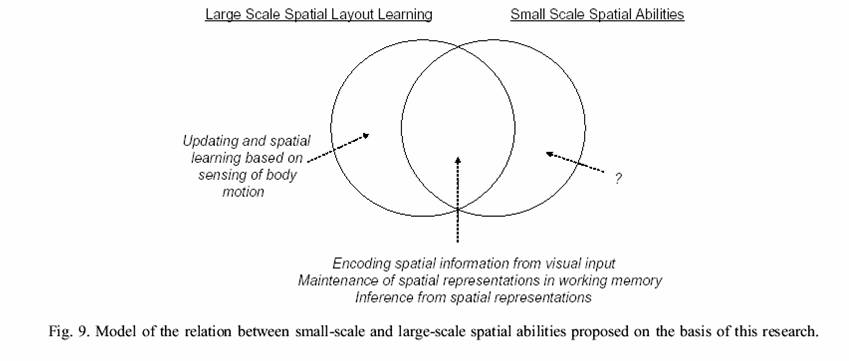 [Double click image to enlarge}
In what way are learning your way around a city your are visiting, playing the XBOX game HALO, and solving visual-spatial tasks on intelligence tests alike? How are they the same? How are they different?
These questions have fascinated me ever since I was recently introduced to the world of HALO. Watching teenagers and young adults play HALO, which requires lighting fast reaction time (Gt), plus the ability to remember the spatial layouts of complex buildings and terrains (from one gaming session to another), has boggled my mind. After considerable “egging on” by some seasoned HALO youth….I gave it a try. To be blunt………I was a disaster.
In my few attempts at HALO, I was killed repeatedly and could not get the action figure I was controlling to do nothing more than spin in circles and fire rounds at my feet or up in the air. Once I learned how move (like a baby), navigating the various maze layouts was daunting. I was completely lost, while the youngsters were literally running and moving around corners, jumping levels, moving through doors, etc., all the while shooting with unbelievable accuracy. They had clearly, via considerable sustatined motivated practice, internalized the spatial configuration of these various virtual environments.
I began to wonder if there was any correlation between visual-spatial psychometric test performance and performance in visual-spatial “wayfinding” in these virtual game environments. Partial answers to my questions were recently answered in the following article published in the journal Intelligence (click here to view/download).
The abstract is below. Also below are a few select conclusions and comments.
- The bottom line is that small-scale psychometric visual-spatial (Gv) tasks do demonstrate significant correlations with navigation in large-scale virtual media environments (HALO), but are not strongly associated with navigation in large-scale real environments (wayfinding in a new city).
- There are large individual differences in large-scale spatial learning. [Comment – no s__t batman!!!! I obviously am at the bottom of the distribution in large-scale virtual reality spatial learning]
- The research supports a model (see graphic above) that suggest partial, rather than total, dissociation between large-scale and small-scale spatial (Gv) abilities.
- Measures of spatial learning from real environments and measures of learning from visual media are partially dissociated and load on different Gv factors. Do these findings, together with the correlated, yet separate, construct validity for psychometric Gv abilities, suggest a need to revise the CHC Gv taxonomy via the inclusion of different types of large-scale navigation Gv abilities? Is there a need to differentiate Gv abilities along the dimension of scale (large- vs. small-scale processing).
- The shared variance between small-scale psychometric Gv and large-scale navigational Gv appears to represent a shared/common visual-spatial processing ability and is not due to the influence of verbal (Gc) abilities or general intelligence (g).
- With myself being an obvious outlier, performance on small-scale psychometric visual-spatial tasks reasonably predicts performance on large-scale visual/virtual media Gv tasks. An obvious question is whether sustained practice on virtual-reality games (e.g., HALO), that place strong demands on visual configuration navigation, visual working memory, visual updating, etc., result in improvement in small-scale Gv performance over time? Is the current generation of video gamers raising the mean level of Gv abilities on traditional psychometric measures?
- Anyone who loves to conduct secondary analysis of published correlation/covariance matrices (via SEM/CFA methods) should find the matrix reported in this article lots of fun.
Hegarty, M., Montello, A. Richardson, A. (2006) Spatial abilities at different scales: Intelligence 34 (2006) 151– 176
Abstract
- Most psychometric tests of spatial ability are paper-and-pencil tasks at the “figural” scale of space, in that they involve inspecting, imagining or mentally transforming small shapes or manipulable objects. Environmental spatial tasks, such as wayfinding or learning the layout of a building or city, are carried out in larger spaces that surround the body and involve integration of the sequence of views that change with one’s movement in the environment. In a correlational study, 221 participants were tested on psychometric measures of spatial abilities, spatial updating, verbal abilities and working memory. They also learned the layout of large environments from direct experience walking through a real environment, and via two different media: a desktop virtual environment (VE) and a videotape of a walk through an environment. In an exploratory factor analysis, measures of environmental learning from direct experience defined a separate factor from measures of learning based on VE and video media. In structural-equation models, smallscale spatial abilities predicted performance on the environmental-learning tasks, but were more predictive of learning from media than from direct experience. The results indicate that spatial abilities at different scales of space are partially but not totally dissociated. They specify the degree of overlap between small-scale and large-scale spatial abilities, inform theories of sex differences in these abilities, and provide new insights about what these abilities have in common and how they differ.
Technorati Tags: psychology, cognition, educaiton, Gv, visual spatial, CHC, CHC theory, XBOX, Halo
Bloggin on the road @ two CA conferences
I'm on the road again. I arrived this afternoon to attend the West Coast Neuropsychology Conference in San Diego (for the first time). I will be here 3 days, and then off to NASP (Anaheim) for 6 more.
I do not think I will attempt to "blog live" (like I did from ISIR) but, I do hope to engage in some form of fyi reports, latest flashes, etc. Heck...I brought my camera and may even post some pics from the conferences.
An upside of travel is that I tend to have more time (usually on planes) to read. I absored two interesting articles on the flight out and will post information regarding them as soon as I can trudle over to a Starbucks to enjoy coffee and wifi. One article is on the relationship between large and small scale Gv abilities and the other a review of the validity of the reading "double deficit" hypothesis.
More later. No promises on how much I blog..nor the content. A guy has to have some fun.
Technorati tags: dyslexia. NASP.
school psychology. learning disabilities. neuropsychology.
I do not think I will attempt to "blog live" (like I did from ISIR) but, I do hope to engage in some form of fyi reports, latest flashes, etc. Heck...I brought my camera and may even post some pics from the conferences.
An upside of travel is that I tend to have more time (usually on planes) to read. I absored two interesting articles on the flight out and will post information regarding them as soon as I can trudle over to a Starbucks to enjoy coffee and wifi. One article is on the relationship between large and small scale Gv abilities and the other a review of the validity of the reading "double deficit" hypothesis.
More later. No promises on how much I blog..nor the content. A guy has to have some fun.
Technorati tags: dyslexia. NASP.
school psychology. learning disabilities. neuropsychology.
Developmental plasticity of the brain
Hat tip to the Eide Neurolearning Blog for the articel re: training and brain plasticity across ages.
Technorati Tags: psychology, cognition, neuroscience, brain, fMRI, neurospcyholgy, education
Training Brains of All Ages
Technorati Tags: psychology, cognition, neuroscience, brain, fMRI, neurospcyholgy, education
Wednesday, March 22, 2006
National principles on defining reading proficiency and accessible large scale assessments
Yesterday the National Accessible Reading Assessment Projects (NARAP), a collaboration of projects funded by the U. S. Dept. of Education, Office of Special Educaiton Programs (OSEP), published "Defining reading proficiency for accessible large-scale assessments: Some guiding principles and issues" (click here to visit web sit and link to paper).
This document is the result of a year long consensus building process and will significantly influence the design and evaluation of large-scale (i.e., state testing) testing programs with regard to making assessments more accessible for students with disabilities. Whether you agree with the defition of reading proficiency included in the report, and/or the general approach (via the articulation of principles) to assessment of reading proficiency, those involved in assessments of kids with disabilities should be aware of the contents of this document....as it will influence the activities of the two major partners in NARAP (DARA and PARA).
[Conlfict of interest disclosure - the blogmaster has a consulting contract with the PARA at the NCEO with regard to this project.
Technorati Tags: education.NCLB, psychology, testing, assessment, state testing, accountability, accessible reading, reading, special educaiton
This document is the result of a year long consensus building process and will significantly influence the design and evaluation of large-scale (i.e., state testing) testing programs with regard to making assessments more accessible for students with disabilities. Whether you agree with the defition of reading proficiency included in the report, and/or the general approach (via the articulation of principles) to assessment of reading proficiency, those involved in assessments of kids with disabilities should be aware of the contents of this document....as it will influence the activities of the two major partners in NARAP (DARA and PARA).
[Conlfict of interest disclosure - the blogmaster has a consulting contract with the PARA at the NCEO with regard to this project.
Technorati Tags: education.NCLB, psychology, testing, assessment, state testing, accountability, accessible reading, reading, special educaiton
Subscribe to:
Posts (Atom)